HSGQ-TC01
| Quantity: | |
|---|---|
HSGQ-TC01 is a box type XGS-PON/GPON Combo OLT. The system has good stability and high reliability. Supports multiple management methods such as CLI, WEB, and SNMP. The product provides 1*XGS-PON/XG-PON/GPON port, 4*GE RJ45 uplink ports and 2*10G SFP+ Slots. Users can quickly deploy, configure, and monitor the device via the cloud management, greatly reducing labor and time costs during network construction. Suitable for sparsely populated and budget limitted areas, smart industrial parks, commercial buildings, FTTR, etc. Each PON port supports a maximum split ratio of 1:128, supports up to 128 users, 1U height is convenient for installation and maintenance. It is an excellent choice for operators to migrate from GPON to 10G PON.
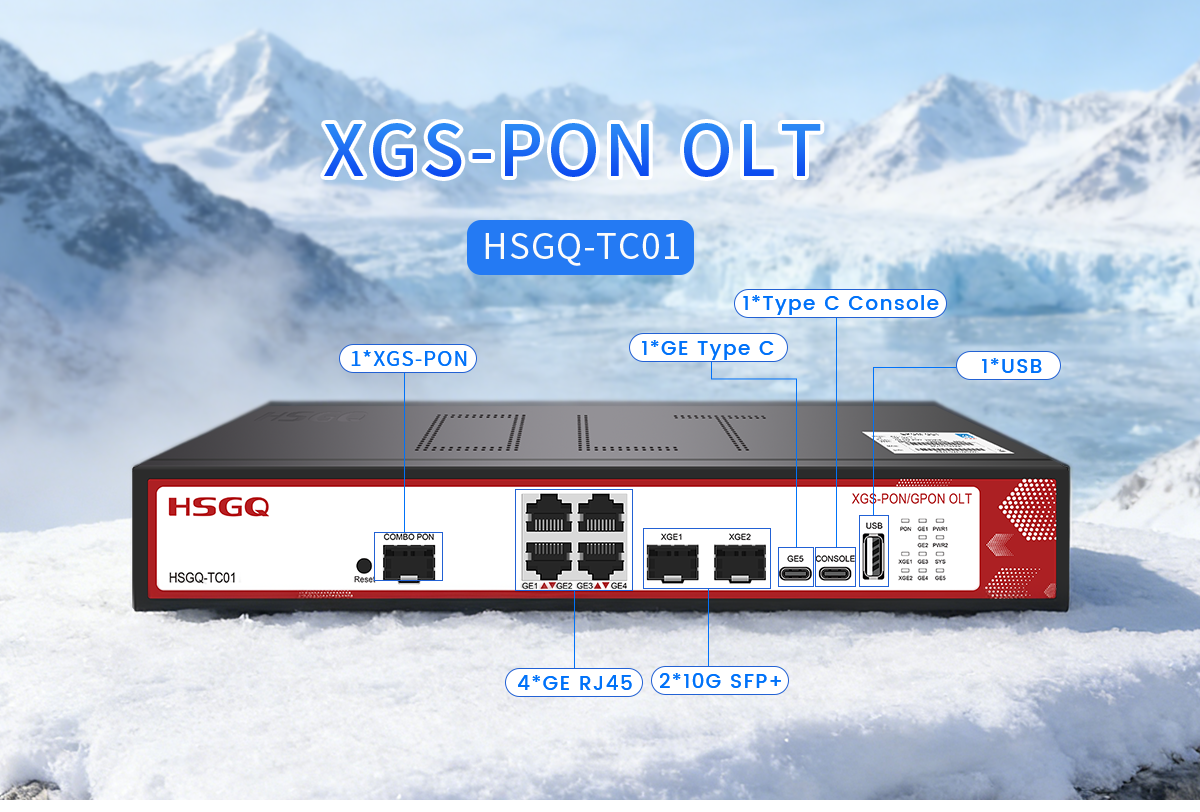
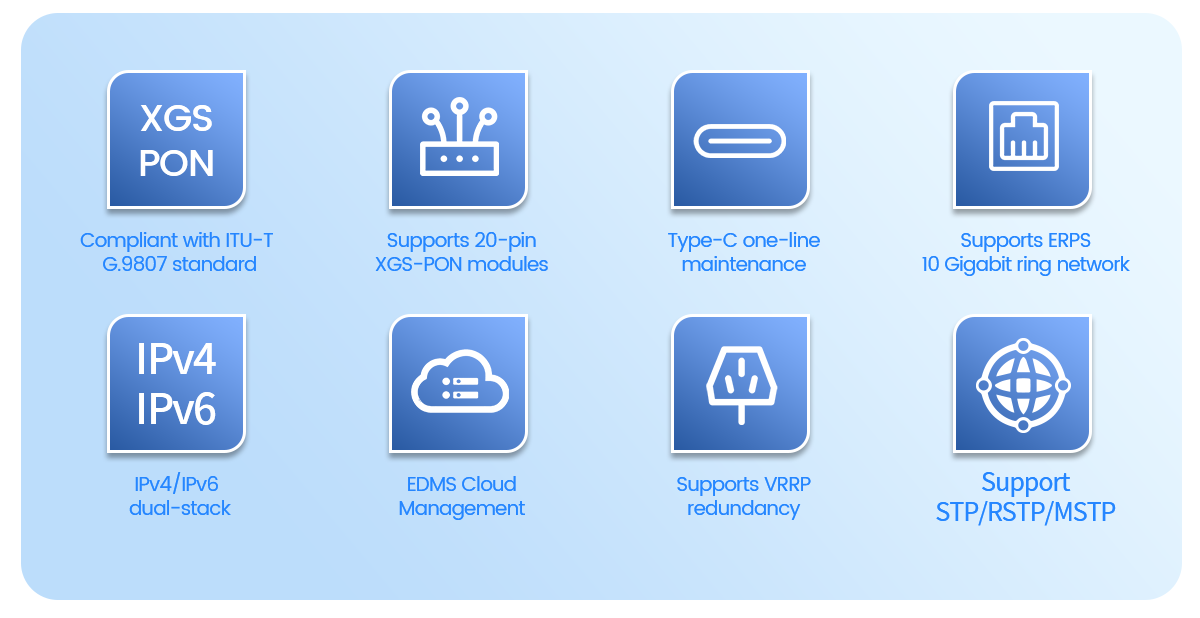
XGS-PON 10G uplink interfaces
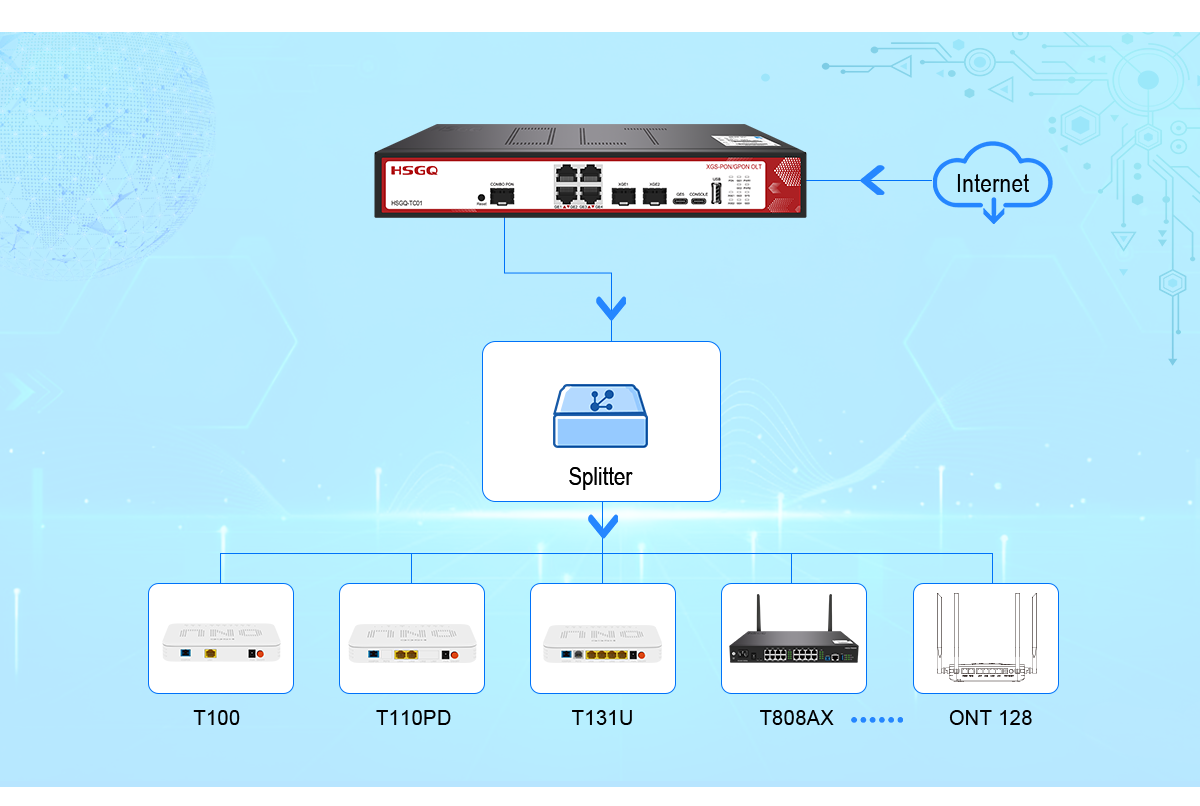
Meets the telecommunications equipment requirements of gigabit broadband, satisfies the needs of next-generation home and commercial applications, and is tailor-made for high-bandwidth application scenarios such as 4K/8K/VR/live streaming.
Type-C Console Port
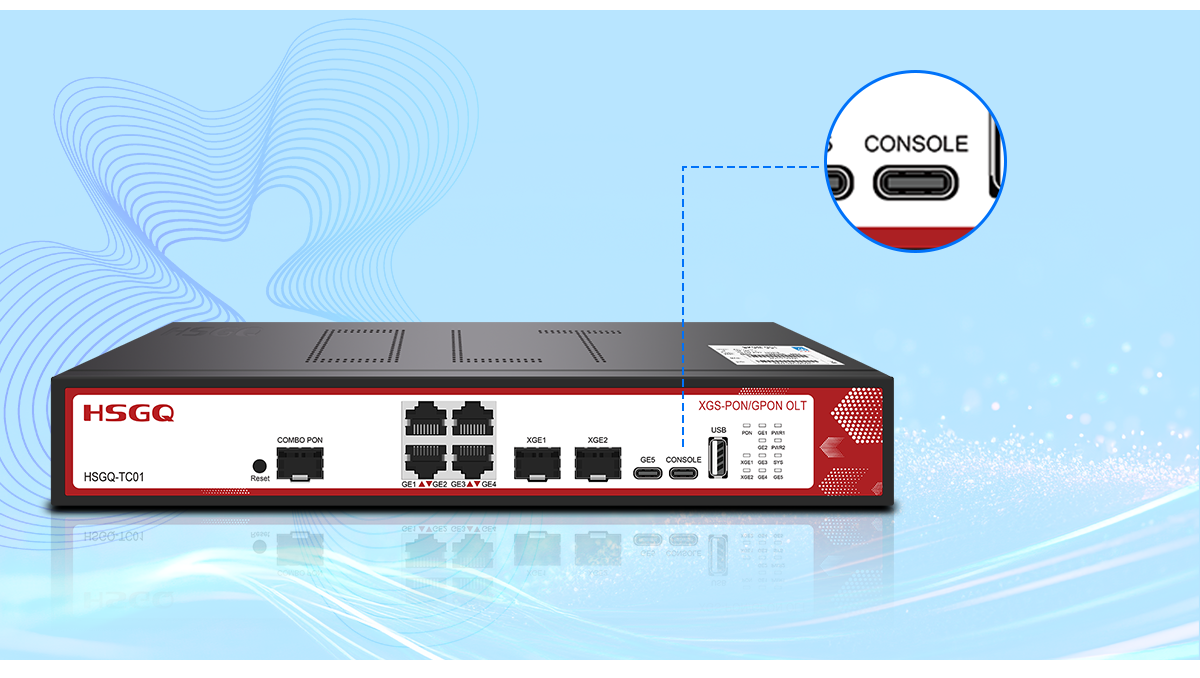
Using a Type-C Console, device configuration management can be solved in one cable.
Supports Layer 3 routing protocols
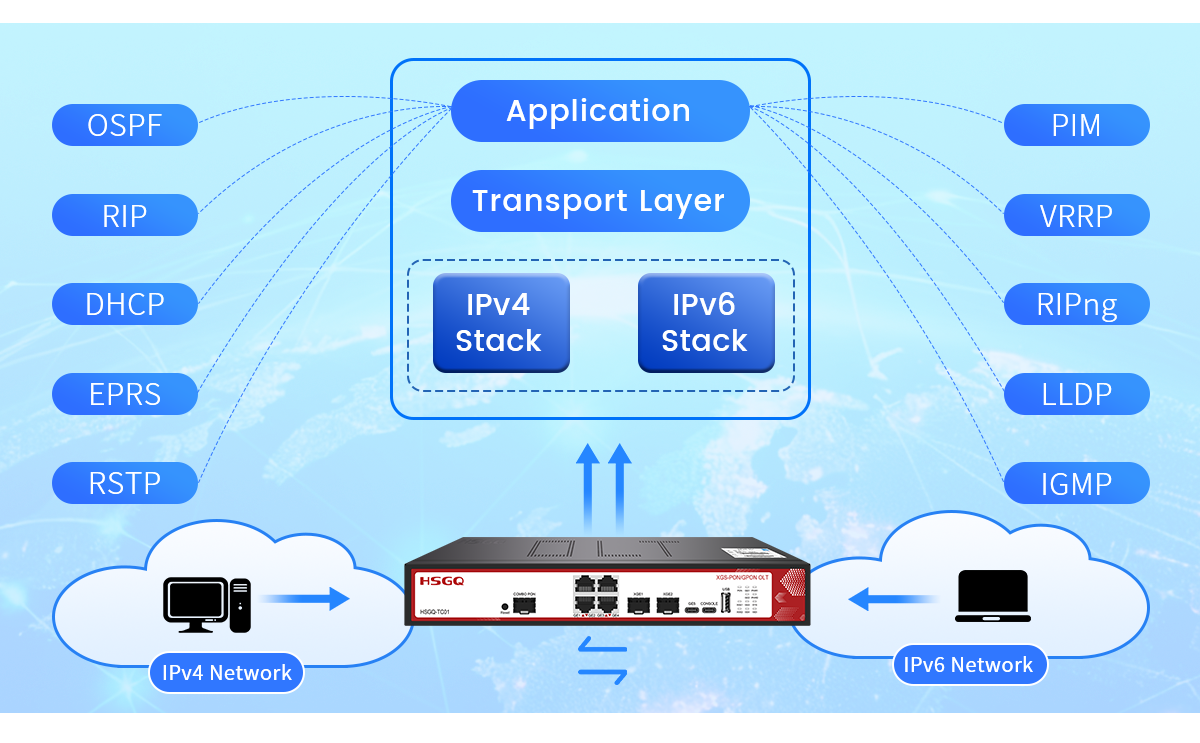
Supports IPv4/IPv6 dual protocol stack, static routing, RIP, OSPF, VRRP redundancy, DHCP, PIM, and IGMP.
Software redundancy design
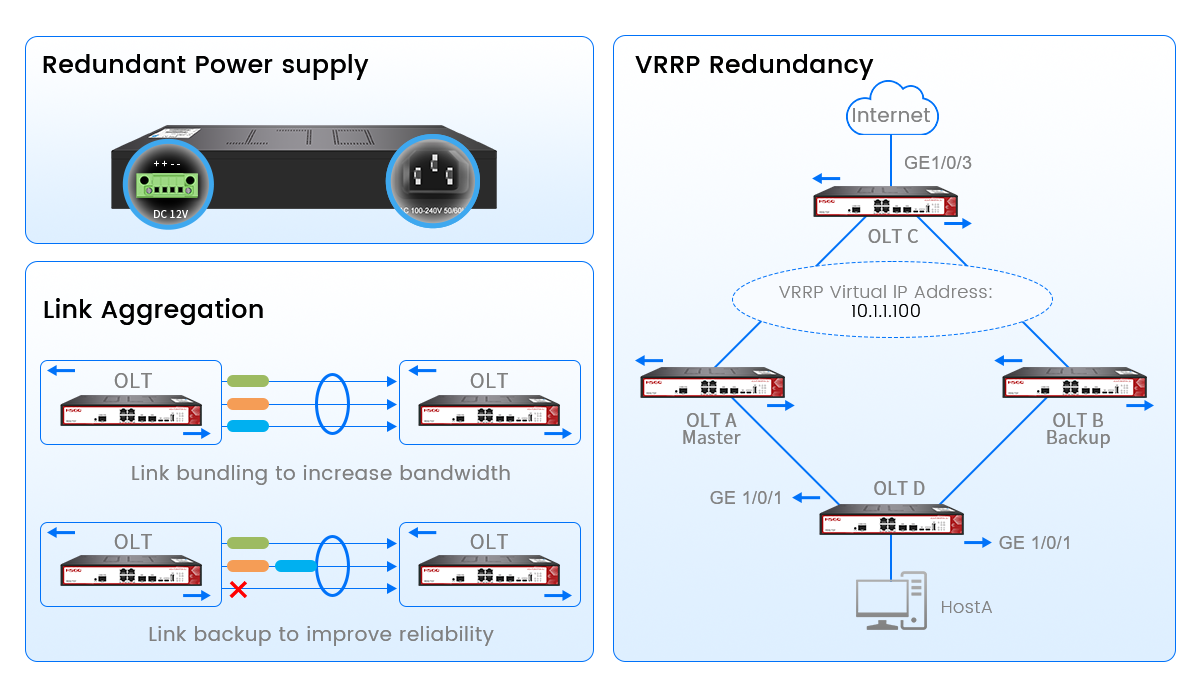
Redundancy Protection: Supports hardware and software redundancy design, including redundant power supplies, redundant link protection, and VRRP redundancy to ensure uninterrupted service.
Supports EDMS cloud
platform management
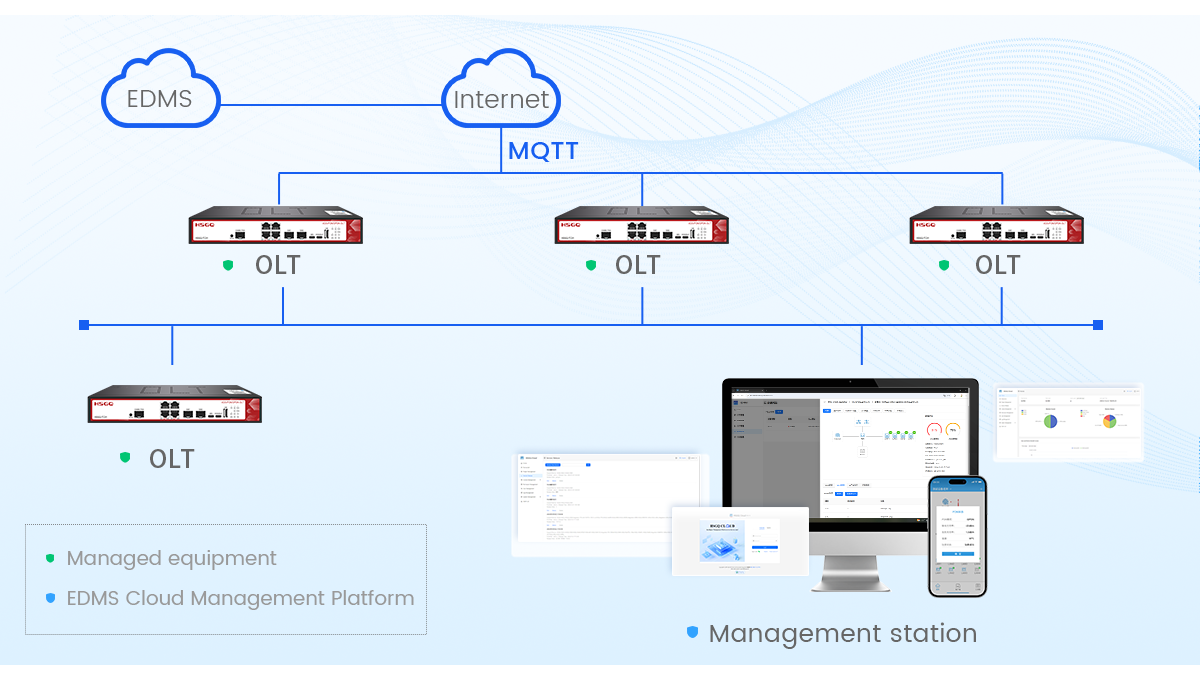
Built-in MQTT function module, supporting connectivity to the EDMS cloud management platform via MQTT/SNMP protocols. This enables unified centralized device management and facilitates remote operation and maintenance.
The HSGQ-TC01 is a compact 1-port XGS-PON/GPON Combo OLT designed for FTTH, FTTR, commercial building, and small-to-medium access network deployments. It combines one XGS-PON/XG-PON/GPON PON interface with four GE RJ45 uplink ports and two 10G SFP+ slots, giving network operators more flexibility when connecting aggregation switches, core routers, or optical transport equipment.
As a 1-port XGS-PON OLT, the TC01 is suitable for networks that need a controlled migration path from GPON to 10G PON without immediately replacing the entire access infrastructure. It supports a maximum 1:128 split ratio per PON port, multiple management methods, Layer 2 and Layer 3 functions, and cloud-based operation.
User Interface | 1*XGSPON/XG-PON/GPON |
4*GE RJ45; 1*GE Type-C | |
2*10G SFP+ | |
1* USB 2.0 | |
PON | PON port: PON SFP+ slot (20 pin) |
Type: XG(S)-PON: Class N1/N2; GPON: Class C++/Class C+++ | |
Split Ratio: 1:128 | |
Bandwidth | XGSPON: Upstream 9.953Gbps@1270nm; Downstream 9.953Gbps@1577nm |
XGPON: Upstream 2.488Gbps@1270nm; Downstream 9 953Gbps@1577nm | |
GPON: Upstream 1.244Gbps @1310nm; Downstream 2.488Gbps @1490nm | |
Flash | 32MB |
DDR | 512MB |
Dimensions | 285*192*44mm |
Weight | 1*Type-C Console |
Power Supply | AC 100V-240V, 50Hz/60Hz; DC 12V |
Environment | Work Temperature: -10°C~55°C |
Storage Temperature: -40°C~80°C | |
Humidity: 10%~95% (Non condensing) | |
Power Consumption | <50W |
PON Features | Support auto register |
ONU white and deny list | |
DBA Configuration | |
Cloud Management | Device List |
Project Management | |
Version Release | |
License Management | |
Configuration and Monitoring | CLI, WEB, SNMP/NMS, CLOUD |
Firmware Upgrade | |
Ping and debug | |
Support User, log and alarm management | |
L2 Function | VLAN transparent, translate, QinQ |
IGMP Snooping/proxy | |
Port Isolation | |
MSTP, RSTP | |
ERPS, LLDP, LACP | |
L3 Function | DHCP |
Static Route | |
OSPF, RIP |
The TC01 uses a 1U box design for easier installation in equipment rooms, cabinets, and compact network cabinets. Its combination PON port can support XGS-PON, XG-PON, and GPON access modes, allowing the network architecture to match the connected ONUs and the required service rate.
The device provides CLI, Web, SNMP/NMS, and cloud management options. This gives installers a local method for commissioning while allowing operators to monitor and maintain distributed OLTs through a centralized platform.
The four GE RJ45 ports are suitable for electrical uplinks in smaller deployments. The two 10G SFP+ slots provide additional optical uplink capacity when the access network requires longer fiber connections or higher aggregation bandwidth.
The product configuration identifies support for ITU-T G.987, ITU-T G.9807.1, and ITU-T G.984.x related PON standards. It also supports 20-pin XGS-PON module applications, IPv4/IPv6 dual-stack operation, Type-C console maintenance, ERPS, STP/RSTP/MSTP, VRRP redundancy, and EDMS cloud management.
These functions make the TC01 suitable for more than a basic PON access role. It can be used as part of a managed access network where traffic classification, ONU authorization, VLAN handling, multicast delivery, routing, and remote maintenance all need to be controlled from the same platform.
The two 10G SFP+ slots provide optical uplink options for connecting the OLT to an aggregation switch, core switch, or upstream transport network. This design is useful when a project needs to reserve more bandwidth for high-density broadband services, business access, enterprise WiFi, video surveillance, or FTTR deployments.
The XGS-PON access side can be connected through a passive splitter to compatible ONUs. The network can then serve residential users, commercial tenants, access points, and other optical terminals over a shared fiber distribution structure.
For projects using an existing GPON user base, the Combo OLT architecture provides a practical migration path. GPON services can remain in operation while XGS-PON capacity is introduced for new subscribers or higher-bandwidth packages. This approach can reduce the need for an immediate all-at-once network replacement.
A 2-port XGS-PON OLT may be more suitable when the project needs two independent PON access ports. The TC01 is better matched to single-PON deployments where compact size, dual 10G uplinks, and gradual migration are the main priorities.
The Type-C console port provides a direct local maintenance interface during installation and troubleshooting. Engineers can use a single cable connection for initial configuration, fault checking, and local device access without depending entirely on remote management.
This is useful during the first deployment stage, especially when the OLT has not yet been connected to the management network. It also provides an alternative maintenance path when the upstream network is temporarily unavailable.
For routine operation, the TC01 can be managed through Web, CLI, SNMP/NMS, or cloud management according to the project’s preferred maintenance method.
The HSGQ-TC01 supports IPv4 and IPv6 dual-stack operation together with Layer 3 functions such as DHCP, static routing, and OSPF. The product documentation also identifies RIP, PIM, IGMP, and VRRP-related functions for network management and service delivery.
DHCP functions can simplify address assignment for connected services, while static routes provide a predictable path for smaller or more controlled network segments. These functions are useful when the OLT participates in a structured access network rather than operating only as a transparent Layer 2 device.
OSPF support can help exchange routing information in larger or segmented network environments. It is useful when the access layer needs to work with an upstream routing architecture and when network paths may change as the topology expands.
IPv4/IPv6 support gives operators more flexibility when deploying new services or preparing for mixed-protocol environments. The exact routing and service configuration should be planned according to the upstream router, ONU capability, and network management policy.
The TC01 supports several functions intended for more resilient network designs, including redundant power supply support, link aggregation, link backup, ERPS, and VRRP-related redundancy.
Link aggregation can combine multiple physical links for additional bandwidth or provide an alternative path if one link becomes unavailable. ERPS and STP-family protocols can help manage Ethernet ring or loop-protection scenarios, while VRRP can be used in supported Layer 3 redundancy designs.
These functions do not remove the need for correct network planning. Power sources, optical modules, upstream switches, routing relationships, and failure paths should be checked before deployment. When correctly configured, the redundancy features can help reduce the impact of individual link or equipment faults.
The TC01 supports EDMS cloud platform management through its built-in MQTT function module and SNMP-related management capability. Operators can use centralized management to organize device lists, manage projects, monitor alarms, perform configuration work, and support remote maintenance.
Cloud management is particularly useful for distributed access networks where OLTs are installed in multiple buildings, industrial parks, offices, or remote equipment rooms. Instead of requiring an engineer to visit every site for routine changes, authorized staff can manage suitable tasks from a central management station.
Local CLI, Web, and SNMP/NMS access remain useful for commissioning, integration, and customers who prefer to keep management within their own network environment.
The TC01 supports flexible Dynamic Bandwidth Allocation and upstream/downstream traffic control. These functions help assign available PON bandwidth according to service requirements and subscriber profiles.
Port-based traffic control and traffic shaping can be used to define traffic policies for connected interfaces. This is useful when different users, services, or network segments require different bandwidth limits.
The OLT supports IP ToS and IEEE 802.1Q VLAN functions for traffic classification and network segmentation. ACL and QoS functions provide additional control over which traffic is permitted and how different traffic classes are handled.
These functions can help separate broadband, management, voice, video, and other services when the upstream and ONU configurations are designed accordingly.
The TC01 supports VLAN transparent transmission, VLAN translation, and VLAN QinQ. These features give operators more options when different network segments use different VLAN plans.
VLAN translation can map VLAN IDs between network sections, while QinQ can add an additional VLAN tag for service-provider or tenant separation. The exact VLAN mode should be confirmed with the upstream switch and ONU configuration before deployment.
Port aggregation allows multiple physical uplinks to be grouped when the network design requires additional bandwidth or link protection. Port-based traffic control and traffic shaping can then be used to apply more deliberate policies to connected services.
This is helpful for commercial buildings, FTTR access networks, and small ISP deployments where several service groups share the same OLT.
The OLT supports automatic ONU discovery, automatic identification, and authorization. This can simplify deployment by helping installers identify connected ONUs during the registration process.
Operators can combine automatic discovery with approved registration policies, ONU lists, service profiles, and management rules to maintain better control over which terminals are allowed to join the PON network.
The automatic loop detection function helps identify abnormal loop conditions in the connected Ethernet network. Broadcast and multicast control, ACL, QoS, and traffic-shaping functions can also support a more organized access environment.
Loop detection should be used together with proper cabling practices and switch configuration. It is a network protection function, not a replacement for physical topology checks.
The TC01 supports flexible and controllable multicast functions together with IGMP snooping. This can help manage multicast traffic for IPTV, video distribution, surveillance, and other one-to-many services.
IGMP-related settings should be coordinated between the OLT, upstream network, splitter architecture, and ONU devices to avoid unnecessary multicast traffic.
The OLT supports Layer 3 functions such as DHCP, static routing, and OSPF. It also supports IPv4/IPv6 operation and can be integrated into access networks that require routing functions closer to the user side.
For projects that only need basic PON aggregation, Layer 2 operation may be sufficient. Layer 3 functions become more useful when the network includes multiple service areas, routing domains, or managed access segments.
The TC01 supports cloud management and is compliant with ITU-T G.987, ITU-T G.9807.1, and ITU-T G.984.x-related requirements listed for the product.
The supported standards help position the device for XG-PON, XGS-PON, and GPON migration projects. Compatibility should still be confirmed with the selected PON modules, ONUs, splitters, and upstream equipment before purchase.
For FTTH deployments, the TC01 can connect the operator’s aggregation network to a passive optical distribution network. The 1:128 maximum split ratio provides a reference for access planning, while actual split levels should be selected according to optical budget, distance, service requirements, and ONU density.
FTTR projects often require greater capacity than traditional GPON access can provide. The TC01’s XGS-PON capability and 10G SFP+ uplinks can support a higher-capacity access architecture when used with compatible ONUs and optical modules.
Commercial buildings, smart industrial parks, and small business campuses may need several service types on one access network. VLAN, QoS, multicast, ACL, routing, and cloud management functions can help separate and manage those services.
The Combo OLT design is useful for operators that need to introduce 10G PON while continuing to serve GPON users. It allows the migration plan to be phased according to subscriber demand, equipment replacement schedules, and available fiber resources.
A conventional 1-port GPON Mini OLT may remain suitable for smaller GPON-only projects, while the TC01 is a better fit when future XGS-PON capacity and higher-speed uplinks are part of the purchasing plan.
Before selecting the TC01 for a project, confirm the following points:
Required PON mode: GPON, XG-PON, XGS-PON, or Combo deployment.
Compatible ONU models and optical modules.
Required split ratio and estimated optical budget.
Number of GE electrical uplinks and 10G optical uplinks.
VLAN, QinQ, multicast, ACL, QoS, and routing requirements.
Whether local CLI/Web/SNMP management or EDMS cloud management is preferred.
Whether redundancy, link aggregation, ERPS, or VRRP functions are required.
Cabinet space, power supply, operating temperature, and maintenance access.
Required firmware, configuration, and interoperability testing before shipment.
The TC01 is specified as an XGS-PON/GPON Combo OLT and supports XGS-PON, XG-PON, and GPON access modes. Compatibility still depends on the installed optical module, ONU model, and service configuration.
The product information specifies a maximum 1:128 split ratio and up to 128 users per PON port. The practical deployment ratio should be determined by optical budget, fiber distance, service load, and project requirements.
Yes. The TC01 provides two 10G SFP+ slots for optical uplink connections. The exact SFP+ module type should be selected according to the upstream equipment, fiber type, distance, and network design.
Yes. The device is suitable for FTTR projects when paired with compatible XGS-PON or GPON ONUs, optical splitters, and distribution equipment. The final design should verify ONU compatibility and optical loss.
The TC01 supports CLI, Web, SNMP/NMS, and cloud management. It also provides a Type-C console interface for local configuration and maintenance.
Yes. IPv4/IPv6 dual-stack operation is supported. DHCP, static routing, OSPF, and other Layer 3 functions should be configured according to the complete network architecture.
A basic GPON OLT is intended for GPON access only. The TC01 adds XGS-PON capability, dual 10G SFP+ uplinks, Layer 3 functions, redundancy options, and cloud management, making it more suitable for phased 10G PON migration.
The product page identifies two 10G SFP+ slots. Whether optical modules are included should be confirmed with HSGQ when requesting a quotation.
Tell us your required PON mode, ONU quantity, split ratio, uplink type, and management needs. Our team can help you evaluate the HSGQ-TC01 for FTTH, FTTR, commercial, and industrial access networks.
Request a Quote View Product Details