Dear Valued Customers and Partners,As the National Day holiday approaches, and amidst the celebration of our nation's enduring achievements, I would like to extend—on behalf of our entire team—our warmest greetings and best wishes to you.
At the recently concluded 27th China International Optoelectronic Exposition (CIOE 2026), HSGQ made a significant appearance, showcasing its all-optical access network solutions.
HSGQ GPON OLTs are optical line terminals designed for high-bandwidth fiber access networks. Based on Gigabit Passive Optical Network technology, they connect the central office with multiple ONUs or ONTs through passive optical fiber, supporting broadband data, voice, IPTV, wireless access, and other converged services.
With high bandwidth utilization, flexible optical splitting, and centralized subscriber management, GPON is suitable for FTTH, FTTB, enterprise parks, smart communities, hotels, and carrier access networks. HSGQ offers 4-port, 8-port, and 16-port GPON OLT configurations for different network capacities and deployment requirements.
A 4-port GPON OLT is suitable for small and medium-sized FTTH, FTTB, enterprise, and community broadband projects. It provides multiple GPON interfaces while maintaining a compact 1U form factor for rack or equipment-room installation.
The 4-Port GPON OLT for FTTH access supports four GPON ports, a 1:128 split ratio on a single PON port, GE electrical uplinks, GE SFP uplinks, 10G SFP+ interfaces, and a console port.
Depending on the network plan, it can support home broadband, small and medium-sized enterprise networks, community access, IPTV, and other multi-service applications.
An 8-port GPON OLT provides more PON-side capacity for multi-building FTTH, enterprise parks, mobile backhaul, and larger residential broadband projects.
The GPON range includes both standard 8-port configurations and integrated models designed for FTTH or outdoor access deployment. Selected models support 10G optical uplinks, cloud management, dual power options, and centralized ONU administration.
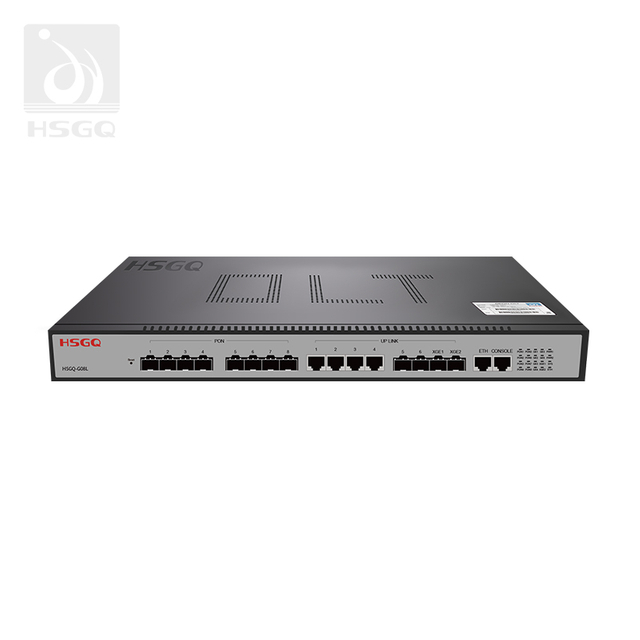
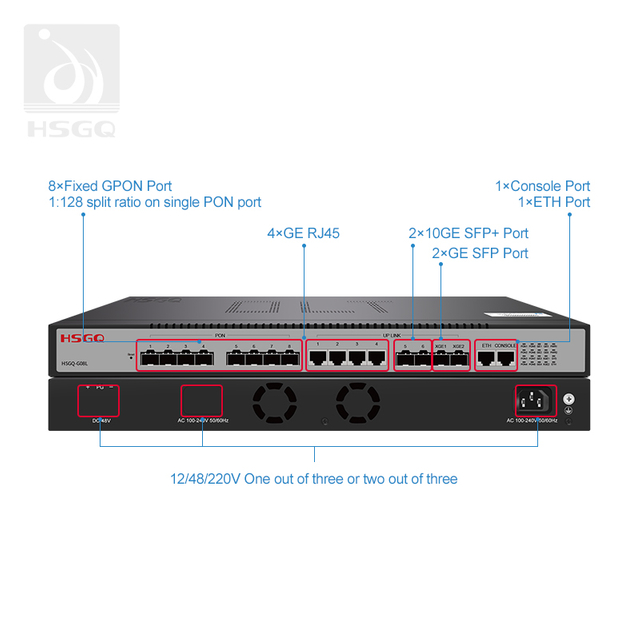
The 8-Port Integrated GPON OLT supports GPON access with 2.5 Gbps downstream and 1.25 Gbps upstream bandwidth, along with GE and 10GE uplink options.
A 16-port GPON OLT is designed for higher-density access networks that serve multiple buildings, larger communities, rural broadband projects, or carrier-grade FTTH deployments.
The 16-Port GPON OLT for FTTH access provides 16 GPON interfaces, GE or combo uplink options, 10G SFP+ uplinks, and dual power redundancy on the relevant configuration.
Selected 16-port models support up to 1:128 splitting per GPON port and up to 2,048 GPON users under full configuration. Actual capacity depends on the model, optical modules, split ratio, optical budget, and network traffic plan.
GPON provides asymmetric high-speed access with a downstream line rate of up to 2.488 Gbps and an upstream line rate of up to 1.244 Gbps. This bandwidth is shared across the ONUs connected to the same PON port through a passive optical splitter.
A GPON OLT with a 1:128 split option can connect a large number of subscriber terminals through a single optical access interface. However, the practical split ratio should be selected according to:
Fiber transmission distance
Optical module class
Splitter insertion loss
Connector and splice loss
Required optical power margin
Number of active users
Expected peak traffic
Service-level requirements
A higher split ratio may increase access density, but it also requires more careful optical budget planning and bandwidth allocation.
A GPON access port may serve many ONUs, so the uplink capacity must be selected according to the expected aggregate traffic. HSGQ GPON OLT models provide different combinations of GE, SFP, combo, and 10G SFP+ uplink interfaces.
Selected models support:
Gigabit Ethernet uplinks
GE SFP optical uplinks
10G SFP+ uplinks
Electrical and optical uplink combinations
Flexible connection to aggregation switches
Uplink traffic control and VLAN management
10G SFP+ uplinks can help reduce congestion between the GPON OLT and the upstream aggregation network, especially in multi-port FTTH, enterprise, campus, and mobile backhaul deployments.
GPON is designed to carry multiple services over a shared fiber access infrastructure. Through traffic classification, DBA, VLAN, and QoS functions, the network can provide different service priorities for different applications.
Depending on the model, HSGQ GPON OLTs may support:
High-speed broadband access
IPTV and multicast video
VoIP and voice services
Wireless AP backhaul
Enterprise dedicated access
Residential broadband
Surveillance and security traffic
Campus network services
Strict DBA and multi-service QoS policies can help allocate upstream and downstream bandwidth according to service requirements. Voice traffic can be assigned higher priority, while video and broadband traffic can be managed through separate VLANs or service profiles.
HSGQ GPON OLTs support centralized management of connected ONUs and ONTs. Depending on the model, administrators can use CLI, WEB, SNMP, Telnet, NMS, or cloud-based management interfaces.
Typical GPON management functions include:
ONU registration and authentication
SN, LOID, and password-based authentication
Standard OMCI management
ONU batch configuration
Batch restart and software upgrades
PON optical parameter monitoring
Automatic ONU registration with default profiles
Port status and traffic monitoring
Alarm and log management
Remote device maintenance
Cloud management is available on selected models. It allows project engineers and network operators to view device status, configure VLANs, receive alarms, and manage multiple OLTs remotely.
GPON networks often serve different subscribers and applications through the same fiber infrastructure. HSGQ GPON OLTs provide a range of switching, routing, and security functions to support service separation and controlled access.
Depending on the selected model, functions may include:
VLAN classification and VLAN translation
VLAN transparent transmission and stacking
QinQ service support
Static routing
DHCP server, relay, and snooping
OSPF on supported models
IGMP snooping and IGMP proxy
STP, RSTP, and MSTP
Link aggregation
Port mirroring
Port isolation
ACL filtering
Anti-ARP spoofing
Anti-ARP flooding
MAC address binding and filtering
Traffic shaping and rate limiting
DSCP and 802.1p priority management
These functions are useful for separating residential broadband, IPTV, VoIP, enterprise, and management traffic while maintaining centralized control of the access network.
HSGQ GPON OLTs use standard 1U rack-mount metal chassis designs for installation in central offices, network cabinets, data rooms, and enterprise equipment rooms.
The hardware design may include:
19-inch rack compatibility
Metal chassis construction
Intelligent fan management
Adjustable-speed cooling fans
Industrial-grade components
AC or DC power options
Optional redundant dual power supplies
Console and out-of-band management interfaces
Selected models support dual AC, dual DC, or AC+DC power configurations. Redundant power can improve network availability by allowing the equipment to continue operating when one power input experiences a fault.
The operating temperature, humidity range, power input, and installation requirements should be confirmed for the selected model.
HSGQ GPON OLTs are designed to support compatible third-party ONU and ONT terminals when the devices follow the required GPON standards and management profiles.
However, compatibility should not be judged only by the GPON label. Before combining products from different manufacturers, confirm:
ITU-T GPON standard support
OMCI compatibility
Authentication method
VLAN and service profile behavior
Optical wavelength
Optical power budget
Firmware and software version
Required management functions
ONU registration and upgrade behavior
This approach helps reduce the risk of brand lock-in while ensuring that the complete GPON access system operates reliably.
GPON OLTs provide centralized fiber access for internet service providers and regional operators. Different port configurations allow the network to scale from smaller access areas to higher-density FTTH deployments.
In apartment buildings and smart communities, GPON can connect multiple floors, homes, and shared facilities through passive optical fiber. A 4-port or 8-port GPON OLT can be selected according to the number of buildings and expected subscribers.
Enterprise parks, school campuses, and institutional sites can use GPON to connect buildings, offices, dormitories, access control systems, and wireless infrastructure through a centralized fiber network.
GPON supports the deployment of all-optical hotel networks by connecting guest rooms, public areas, offices, IPTV systems, and wireless access points through a unified fiber infrastructure.
With a maximum transmission distance of up to 20 km on selected models, GPON can support rural broadband projects and other applications where fiber access points are distributed across a wide area.
GPON can also be used in selected mobile backhaul and enterprise access scenarios where high-density fiber connectivity, centralized management, and multi-service support are required.
The best GPON OLT depends on the complete network plan rather than the port count alone.
Before requesting a quotation, evaluate:
Required GPON port count
Number of planned ONUs or ONTs
Expected split ratio
Fiber distance
Optical budget
GE, SFP, combo, or 10G SFP+ uplink requirements
IPTV, voice, broadband, or enterprise services
VLAN, QoS, Layer 3, and multicast functions
Cloud or local management requirements
Redundant power requirements
Indoor, cabinet, or outdoor installation conditions
Compatibility with the selected ONU terminals
Expected future expansion
A 4-port GPON OLT may be appropriate for small and medium-sized access projects. An 8-port model can support larger enterprise, community, and multi-building networks, while a 16-port GPON OLT is better suited to higher-density FTTH and carrier access deployments.
If the project requires a compact desktop OLT rather than a standard rack-mount platform, compare the Mini OLT range. If an SFP-form-factor solution is required, review the GPON Stick OLT category.
A GPON OLT is the central office device that connects a service provider or enterprise network to multiple GPON ONUs or ONTs through passive optical fiber. It manages subscriber access, bandwidth allocation, VLAN services, and optical links.
A standard GPON OLT is usually a rack-mount or box-type device with multiple PON ports, uplinks, and management interfaces. A GPON Stick OLT is an SFP-form-factor device designed for direct installation in a compatible switch or host platform. The two products are intended for different network architectures.
The number of ONUs depends on the number of GPON ports, split ratio, optical budget, and product configuration. Selected HSGQ models support up to 1:128 splitting per PON port. A 16-port model can support up to 2,048 GPON users under full configuration according to the relevant product specification.
No. A 1:128 split ratio refers to the number of optical terminals that can share one PON interface. The available bandwidth is shared among connected users and controlled through DBA, QoS, service profiles, and traffic policies.
It may work with compatible third-party ONUs when the GPON standard, OMCI behavior, authentication method, VLAN configuration, and firmware are compatible. Cross-vendor interoperability should be tested before large-scale deployment.
A 10G uplink is useful when several GPON ports aggregate high subscriber traffic or when the OLT connects to a high-capacity aggregation network. Smaller projects may not require 10G, while multi-building, enterprise, carrier, and mobile backhaul networks may benefit from it.
Neither standard is universally better. GPON generally offers higher downstream bandwidth and strong multi-service support, while EPON provides Ethernet-based operation and can be attractive for cost-sensitive deployments. The decision should consider existing ONU compatibility, service requirements, network scale, and total project cost. A detailed comparison is available in the GPON vs EPON OLT guide.
GPON OLT pricing depends on the number of PON ports, uplink interfaces, optical modules, ONU capacity, Layer 2 or Layer 3 functions, cloud management, power redundancy, chassis design, and required customization. For an accurate quotation, provide the number of users, fiber distance, desired split ratio, uplink bandwidth, and ONU type.