To meet the growing demand for gigabit and ultra-gigabit (2000Mbps+) broadband services and address the bandwidth bottlenecks of traditional GPON networks when handling 4K/8K video, ultra-high-definition live streaming, VR, and enterprise-level cloud applications, HSGQ has launched the XGS-PON compact box-type OLT solution for next-generation all-optical access networks.
HSGQ's newly developed single-port and dual-port XGS-PON Combo OLT core devices are designed to provide small and medium-sized ISPs, industrial parks, commercial buildings, FTTRs, and sparsely populated or budget-constrained areas with a low-cost, high-bandwidth, and smoothly upgradable all-optical network deployment path.
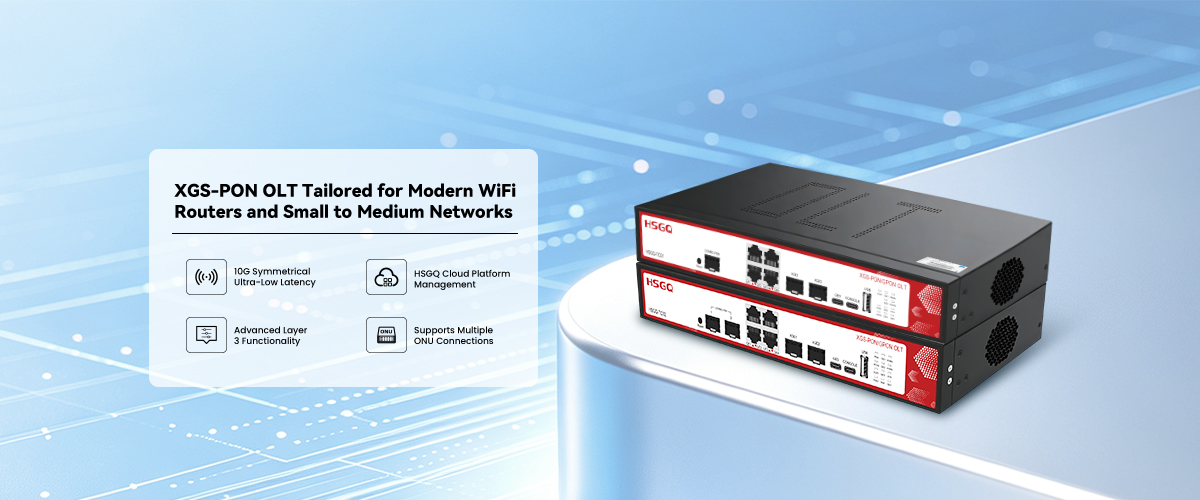
I. Core Equipment Overview
The HSGQ-TC series OLT used in this solution is a 1U compact box-type device with extremely high deployment flexibility.
 |  | |
| HSGQ-TC01 | HSGQ-TC02 | |
| Downlink Ports | 1 XGS-PON/XG-PON/GPON tri-mode combo port. | 2 XGS-PON/XG-PON/GPON tri-mode combo ports. |
| Uplink Interfaces | 2*10G SFP+ optical ports, 4*GE RJ45 electrical ports. | 2*10G SFP+ optical ports, 4*GE RJ45 electrical ports. |
| Capacity | At a 1:128 split ratio, a single device can connect 128*user. | At a split ratio of 1:128, a single device can connect 256*user. |
II. Core Solution Advantages
1. Smooth Upgrade and Tri-Mode Combo Compatibility
The biggest highlight of this solution is its downlink PON port's use of Combo technology, simultaneously compatible with three modes:
●XGS-PON: Symmetrical uplink and downlink speeds of 9.953 Gbps.
●XG-PON: Downlink 9.953 Gbps, Uplink 2.488 Gbps.
●GPON: Downlink 2.488 Gbps, Uplink 1.244 Gbps.
This means that operators do not need to replace existing optical splitters and traditional GPON ONTs/ONUs when upgrading their networks. Existing users can continue using GPON, while newly activated high-end users can directly adopt XGS-PON, achieving a seamless network transition and greatly protecting asset investment.
2. 10G Uplink Network Removing Uplink Bottlenecks
Traditional small OLTs are often limited by gigabit uplink ports. This solution features two 10G SFP+ uplink slots, fully unlocking the potential of 10G fiber optic connections. Dual 10G uplinks not only perfectly handle the massive concurrent traffic of the downlink PON ports, but also provide highly reliable dual uplink redundancy through link aggregation or ring network protection.
3. Simplified Operation and Maintenance & Cloud Management
Addressing the pain point of small and medium-sized ISPs and campuses lacking professional network administrators, this solution supports the EDMS cloud management platform.
● The device has a built-in MQTT module, enabling automatic cloud connection.
●Technicians can remotely monitor device lists, manage projects, distribute configurations, upgrade firmware, and handle alarms via the cloud, significantly reducing the manpower and time costs of on-site maintenance.
● The device has a front-facing Type-C Console interface, allowing for local testing with just a standard data cable.
4. High Reliability and Intelligent Self-Healing
● Loop Detection and Self-Healing Mechanism: Features hardware-level intelligent loop detection. When a network loop occurs, the OLT can automatically block the faulty port to prevent a broadcast storm from paralyzing the entire network; once the loop is cleared, the port can automatically resume normal communication.
● Layer 3 routing and full-featured support: Supports IPv4/IPv6 dual stack, supports static routing, RIP, OSPF and other Layer 3 dynamic routing protocols, supports VRRP redundancy protection, and can also function as a small core/aggregation node in a regional network.

III. Typical Application Scenarios
Scenario 1: Smart Industrial Parks and High-End Commercial Buildings
● Pain Point: Enterprises require gigabit symmetrical networks for video conferencing and cloud-based big data transmission, but traditional equipment occupies a large amount of server room space.
● Solution: Deploy a dual-port XGSPON OLT in the building's weak current shaft or mini cabinet. Two PON ports are used to split the optical connection to each enterprise's XGS-PON WiFi 6 ONU within the building. It provides symmetrical 10G bandwidth, and with Layer 3 OSPF protocol and ACL/QoS policies, ensures the bandwidth and security of the enterprise's critical business.
Scenario 2: Remote and Low-Density Population Areas (Broadband Access for Small and Medium-Sized ISPs)
● Pain Point: Dispersed users, limited initial network construction budget, and high cost of deploying traditional large-capacity rack-mount OLTs.
● Solution: Use a single-port xGSPON OLT to establish a base station locally with extremely low initial investment. A single port can cover up to 128 fiber broadband users, with direct uplink access to the 10G backbone network. As the number of users increases, devices can be stacked at any time or seamlessly upgraded to multi-port devices.
Scenario 3: High-end Home FTTR and WiFi Router Networking
●Pain Point: In large apartments or villas, traditional network cables or WiFi repeaters cannot meet the needs of ultra-high bandwidth coverage exceeding 2000Mbps.
● Solution: Use the HSGQ-TC01/TC02 as a "mini central office" in the home or villa, with fiber optic cables extending directly to WiFi-enabled ONUs/ONTs in each room. The OLT hardware supports low-latency SoC chip acceleration, significantly reducing game jitter and online class latency, achieving true gigabit/10-gigabit fiber optic coverage throughout the house.
IV. Summary
HSGQ's XGS-PON compact box-type OLT solution perfectly addresses the pain points of small and medium-sized network scenarios in the current global network evolution towards 10G PON. Whether for independent ISPs looking to control new construction costs or industrial parks requiring network digital upgrades, this solution is an ideal choice that balances technological advancement with economic feasibility.