Views: 0 Author: Site Editor Publish Time: 2026-07-06 Origin: Site
Extending fiber to ceilings, rooms, and remote service areas solves the data problem, but active endpoints still need a practical source of power. PoF addresses that gap by combining optical connectivity with remote power delivery, reducing dependence on nearby outlets and long copper runs. Choosing the right architecture, however, depends on where each device belongs. A PoF router handles centralized distribution, a PoF ONU converts the remote link into Ethernet or PoE outputs, and PoF Optical Fiber for Ceiling AP deployments support direct wireless coverage. Understanding these roles helps planners match topology, capacity, and endpoint requirements before installation.
A typical link begins at the OLT or another PON uplink and then reaches a central PoF router. Optical-electrical hybrid cables branch from that point toward remote ONUs or ceiling-mounted APs. The fiber element carries GPON or EPON traffic, while the conductive element supplies the voltage required by the endpoint. Combining those paths in one cable assembly removes the need for a separate local adapter at every terminal.
The central unit should not be confused with a household Wi-Fi router. Here, it behaves as a powered optical distribution platform that accepts the upstream PON connection, splits service into several branches, and feeds compatible endpoints. The F32R integrates a 1+32-channel optical distribution unit with 32 PoF outputs and a cascade connection. It supports links of up to 300 meters under compatible deployment conditions.
The first endpoint path runs directly from the PoF router to a ceiling AP. It works well when the remote location mainly needs wireless service because optical access, remote power reception, and Wi-Fi are combined in one device. Fewer boxes are installed above the ceiling, and no separate ONU is required only to feed the AP.
The second path places a PoF ONU between the central unit and conventional Ethernet equipment. That arrangement is more flexible when the remote zone needs cameras, IP phones, access control, a separate AP, or several wired ports. Distance alone should not determine the design. The deciding question is what services and interfaces must be available after the hybrid cable reaches the endpoint.
The PoF router belongs in the equipment room, rack, or another controlled location. It receives the PON feed, divides it into remote links, and allocates power across those branches. Centralization reduces dependence on scattered outlets and simplifies backup power, load planning, and branch maintenance.
Port count is only one selection factor. Designers must also check per-branch power, total capacity, supported distance, optical mode, environmental limits, and cascading needs. The F32R includes 32 PoF SC outputs, one PON input, one cascade output, up to 80 W per branch, and an 800 W total limit. It suits dense hotel, campus, park, or surveillance layouts.
A PoF ONU terminates the optical connection and presents standard interfaces for downstream devices. It bridges the all-optical backbone and the final Ethernet segment, sometimes acting as PoE power-sourcing equipment as well. The correct model depends mainly on endpoint count and power demand.
For a one-device branch, the HSGQ-F100P provides one Gigabit RJ45 interface with PoE+ output up to 30 W. It supports GPON/EPON self-adaptation, accepts 48–57 V PoF input, and supports a maximum hybrid-link distance of 300 meters in compatible configurations. Its device consumption remains below 10 W, which must be included in the branch power budget.
Where several devices share one zone, the HSGQ-F400P offers four Gigabit RJ45 ports. It supports IEEE 802.3af/at output, up to 30 W per port, and up to 120 W in total, alongside GPON/EPON adaptation and 48–57 V input. This layout can serve an AP, cameras, phones, or other powered equipment without a separate switch, provided the upstream branch sustains the combined load.
A ceiling AP combines optical access, remote power reception, and wireless coverage in one enclosure. It suits locations where Wi-Fi is primary and extra wired ports are secondary. Placement can follow the radio-frequency plan instead of the nearest socket.
The F881 supports PoF Optical Fiber for Ceiling AP deployment. It combines AX3000 Wi-Fi 6, a Gigabit LAN port, a 2.5GE interface, GPON/EPON adaptation, and OMCI/TR-069 remote maintenance. It also supports hybrid-cable power input and a transmission distance of up to 300 meters. The device therefore acts as a direct wireless endpoint rather than an ONU that merely feeds another AP.
Hotels, schools, offices, shopping areas, and conference venues often need APs spread across ceilings and corridors. A direct ceiling endpoint keeps the installation compact because one hybrid cable replaces separate fiber access, a local ONU, a power adapter, and an additional data lead. This arrangement is suitable for offices, schools, shopping malls, hotels, and other indoor spaces requiring multiple distributed APs.
The strongest reason to choose this layout is placement freedom. Wireless design depends on coverage overlap, user density, roaming, channel planning, building materials, and interference, none of which necessarily align with existing outlets. A direct AP can be installed where the RF survey requires while retaining centralized power and optical backhaul. Removing a separate adapter also reduces ceiling-side components.
This architecture still has limits. If the same location must connect several cameras, phones, access-control readers, or workstations, an integrated AP may not offer enough interfaces. A PoF ONU is then the better endpoint because it can distribute Ethernet or PoE locally. The direct option should be selected for wireless-first zones, not simply because it uses fewer devices.
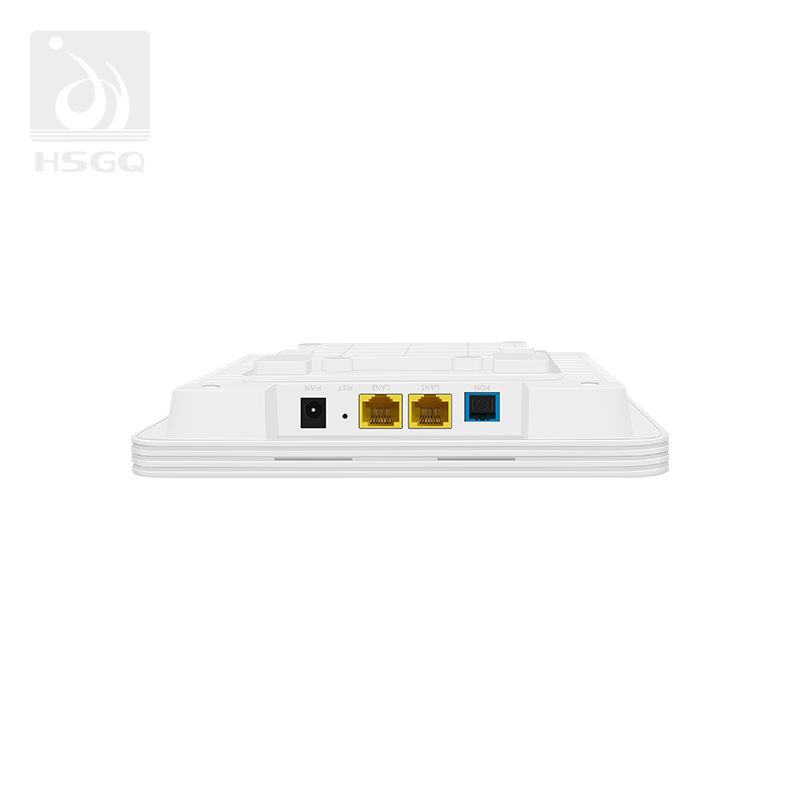
One Device or Several Devices: Choose the ONU Port Count
A single-port ONU fits a branch with one defined endpoint, such as an AP, camera, access-control terminal, or compact gateway. The design keeps fiber and remote power centralized while preserving a standard RJ45 connection at the final device. It also allows the ONU and downstream equipment to be upgraded separately.
A four-port model suits several devices in the same room, cabinet, corridor node, or surveillance position. One PoF ONU can provide local connections for an AP, cameras, phones, or other powered equipment, reducing the number of optical terminals. That convenience creates a shared dependency, however, because one ONU failure can affect the whole local cluster.
Port count must be paired with a realistic load estimate. Four ports rated at 30 W each do not guarantee that every branch can deliver 120 W after cable loss, ONU consumption, and central allocation are considered. Future expansion may justify spare ports, but unused capacity should be planned rather than assumed. The best endpoint matches the actual device mix, criticality, and growth path.
Published reach is a design boundary, not a universal promise. The F32R, F100P, and F881 support transmission distances of up to 300 meters, but the achieved result depends on compatible cable, conductor resistance, connectors, load, and installation conditions. Measure risers, service loops, cabinet entry, and detours rather than straight-line distance.
Optical and electrical losses must be checked separately. The fiber path is governed by transmitter power, receiver sensitivity, splitters, connectors, and splices, while the power path depends on conductor gauge, length, current, voltage drop, and temperature. A branch may pass the optical budget but still deliver insufficient voltage under peak load. Confirm the PoF connector format, polarity, cable rating, bending radius, and termination method before installation.
Begin with the actual operating and peak demand of each AP, camera, phone, or controller. Add the ONU or integrated AP’s own consumption, then account for cable loss and an engineering reserve. Working backward from the farthest endpoint exposes the likely limiting branch.
Required central power ≥ endpoint load + remote terminal consumption + cable loss + reserve
A 30 W PoE output rating describes the downstream interface limit, not necessarily the power remaining at the end of every long branch. The F100P consumes less than 10 W, while the F881 consumes less than 12 W; those internal loads reduce the available margin. The F400P can provide up to 120 W total, but its upstream supply, conductor size, and central allocation must sustain that demand.
Power compatibility alone does not guarantee a workable network. The OLT, PoF router, ONU, and ceiling AP must agree on PON mode, optical levels, provisioning, and management. The F32R, F100P, F400P, and F881 support GPON/EPON self-adaptation, but interoperability should still be verified in the intended OLT environment.
Use a branch record before ordering equipment:
● Network compatibility: PON mode, OLT profile, optical budget, VLANs, multicast, IPv4/IPv6, and provisioning
● Distance and cabling: Routed length, cable type, conductor gauge, connectors, splices, bend radius, and environment
● Endpoint power: Normal draw, peak draw, terminal consumption, voltage drop, and reserve
● Port capacity: 1GE or 2.5GE requirement, PoE or PoE+ demand, per-port limit, and total limit
● Management and maintenance: OMCI, TR-069, cloud or local access, rate control, labeling, reboot method, and expansion
Bandwidth must be checked at every conversion point. A fiber-fed network may still be constrained by a 1GE user port, PON service profile, slower endpoint, or real wireless capacity. Management functions such as remote provisioning, VLAN handling, rate limits, and fault isolation also determine whether the installation remains maintainable. Build the final bill of materials from a branch-by-branch schedule rather than a rough device count.
A practical PoF network depends on matching each device to its role rather than choosing equipment by port count alone. The PoF router handles centralized distribution, the PoF ONU converts the remote optical link into Ethernet or PoE, and PoF Optical Fiber for Ceiling AP deployments bring power and wireless access directly to the coverage point. Shenzhen HS Fiber Communication Equipment CO., LTD. provides these device options for different network positions, helping planners reduce local power wiring, simplify terminal deployment, and build layouts that better fit actual distance, capacity, and endpoint requirements.
A: PoF combines optical data transmission with remote power delivery through a compatible hybrid connection, allowing active devices to operate without a nearby outlet or separate power adapter.
A: A PoF router distributes PON connectivity and centralized power across multiple branches. A PoF ONU terminates one branch and provides Ethernet or PoE ports for connected devices.
A: Yes. A compatible ceiling AP can receive network access and operating power through the hybrid cable, reducing the need for a nearby outlet, adapter, or separate copper run.
A: Reach depends on cable resistance, connectors, endpoint demand, and reserve capacity. Compatible PoF router, ONU, and ceiling AP configurations can support distances of up to 300 meters.
A: Use a single-port model for one AP, camera, or gateway. Choose four ports when several nearby devices share one branch and the available power budget supports them.