Views: 0 Author: Site Editor Publish Time: 2026-06-29 Origin: Site
Fiber can carry high-speed data to a ceiling AP or remote ONU, yet the device still needs reliable power. That gap can require separate outlets or copper runs where installation is difficult. PoF addresses the problem by pairing optical connectivity with centrally supplied power, although the term can describe either laser-based optical power conversion or hybrid fiber cabling with dedicated conductors.
Recognizing the difference prevents mistaken assumptions about distance, isolation, efficiency, and compatibility. The following sections explain how a PoF link works, how a PoF router connects to a PoF ONU or ceiling AP, and where the technology offers value.
A PoF link begins in an equipment room or communications cabinet. Upstream traffic enters from an OLT, gateway, or aggregation device, while a central supply provides energy for the remote terminals. Data is launched onto optical fiber, power follows the selected delivery path, and the endpoint uses both inputs to operate its Ethernet, Wi-Fi, or processing functions. The sequence is straightforward, but each stage must be designed as part of one system.
Two budgets determine whether the link works reliably. The optical budget accounts for splitter, connector, splice, and fiber losses, while the electrical budget checks voltage and wattage at the endpoint. A receiver may report normal optical levels yet reboot because the delivered voltage falls below its operating range. Testing only the data path therefore gives an incomplete picture.
True optical PoF uses light as the energy carrier. A laser source converts electrical input into optical power, the fiber transports it, and a photovoltaic power converter produces DC electricity at the far end. The light source, fiber, and converter form the three core elements, with performance influenced by wavelength, distance, conversion efficiency, and power-handling limits.
Hybrid fiber PoF works differently. Optical strands carry GPON, EPON, or Ethernet traffic, while copper conductors inside the same composite cable deliver electrical power. This approach avoids optical-to-electrical conversion in the power path and is commonly used for router-to-ONU and ceiling AP connections. However, the cable is not fully non-conductive and should not be assigned the isolation benefits of true optical powering.
In a hybrid cable, data and power share an outer sheath but remain physically separate. Voltage drop on the conductors does not directly weaken the optical signal, and optical attenuation does not reveal how much electrical power reaches the device. Engineers must calculate conductor resistance, cable length, current demand, and far-end voltage independently from the optical link budget. The correct question is not merely how far the fiber reaches, but whether the complete link delivers valid data and adequate power.
The PoF router is the hub of a hybrid access network. It receives the optical feed, distributes the signal to multiple branches, and supplies DC power to compatible remote ports. Planning should cover output count, total wattage, per-port limits, PON mode, and maximum cable length.
HSGQ’s F32R illustrates this architecture. It combines a 1+32-channel optical distribution section with a 32-channel 48 V power supply, supports GPON and EPON adaptation, and uses optical-electrical composite cable. The model supports links of up to 300 meters, provides up to 80 W per port, and has a total power capacity of 800 W.
A PoF ONU terminates the optical access link and presents services such as Ethernet or Wi-Fi. A basic terminal may offer one Gigabit port, while room-oriented models can add multiple interfaces, wireless access, or downstream power output. The selected unit must match the PON protocol, optical receive range, connector arrangement, input voltage, and intended service profile. Similar product names alone do not guarantee interoperability.
Cable bend radius, ventilation, connector access, and replacement clearance should be checked before mounting an ONU above a ceiling or inside an enclosure.
A ceiling AP should be placed where radio coverage requires it, not where an outlet happens to exist. PoF optical fiber for ceiling AP deployment can provide data and operating power through one planned route, which is useful across hotels, schools, offices, and long corridors. The design still needs a realistic allowance based on peak consumption, since radio count, Wi-Fi generation, and transmit power affect wattage.
HSGQ provides optical routers, PoF ONU terminals, and optical ceiling APs that can be combined within a coordinated access-network ecosystem.
Component | Main role | Data function | Power responsibility | Key selection check |
OLT or gateway | Provides upstream access | Launches the optical signal | Separate from endpoint power | Protocol and capacity |
PoF router | Centralizes distribution | Splits or forwards traffic | Powers remote branches | Port and total wattage |
Hybrid cable | Connects both ends | Fiber carries data | Conductors carry DC | Length and conductor size |
PoF ONU | Terminates the link | Provides Ethernet or Wi-Fi | Receives central power | Optical range and voltage |
Ceiling AP | Delivers wireless access | Serves user devices | Uses remote power | Coverage and peak demand |
The challenge in a large indoor network is rarely one difficult AP; it is repeating the installation across many rooms, floors, and ceilings. Separate outlets and adapters add coordination work and may force devices away from their best coverage positions. A centralized PoF layout creates a more consistent branch design by returning connectivity and power to the communications room. Its value lies in deployment flexibility, not in improving radio performance by itself.
Hotels and schools are natural fits because rooms, classrooms, corridors, and shared spaces repeat. Offices with changing layouts may also benefit when AP positions need to follow coverage demand.
Fiber-to-the-room projects may place an ONU in every apartment, hotel room, dormitory, or office zone. Without remote power, each terminal needs an adapter and a local outlet, increasing visible hardware and complicating backup-power planning. A PoF ONU can receive optical service and centralized power, then provide Ethernet or Wi-Fi locally. This can simplify room layouts.
The advantage depends on an end-to-end compatible design. Router ports, composite cable, connectors, voltage, and ONU interfaces must be selected as one system. Mixing loosely compatible components can erase the maintenance benefits that centralized power was meant to create.
PoF becomes more relevant when an endpoint lies beyond a convenient copper Ethernet run or where local electrical work is costly. Campus buildings, warehouses, office parks, outdoor facilities, surveillance points, and long corridors can create that condition. Fiber preserves the data path over longer access distances, while centralized power reduces dependence on a separate supply at every remote location. The result can be a cleaner architecture.
Outdoor and inter-building routes still require careful protection. Hybrid conductors may need surge control, grounding, water resistance, UV resistance, and mechanical protection. True optical powering offers stronger isolation for specialized sensors, but it serves a different power range than an access-network ONU.
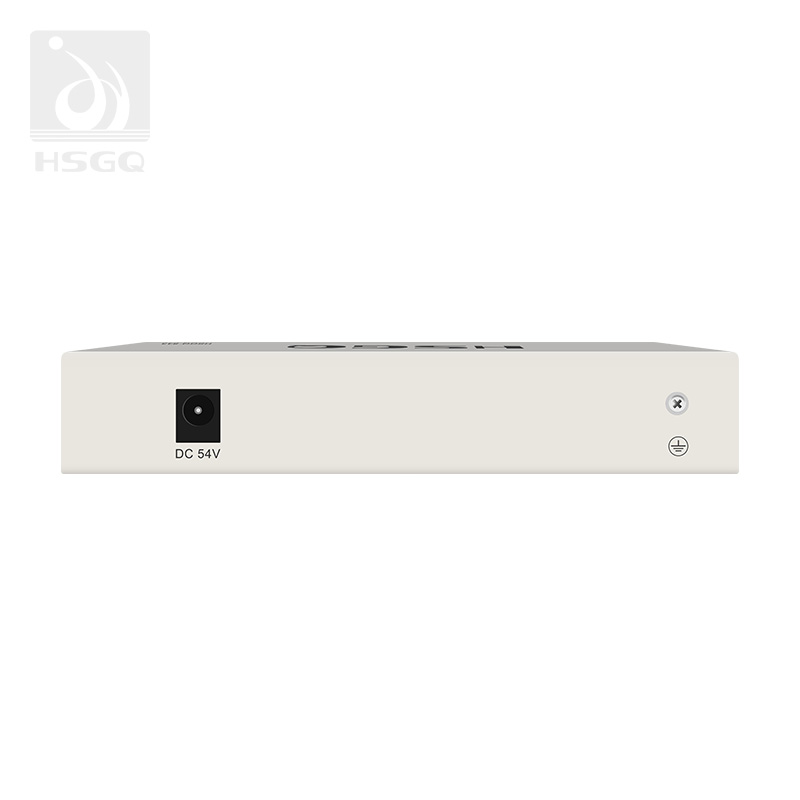
A combined fiber-and-power route lets designers place an ONU, camera, or AP according to coverage and service needs rather than outlet location. Ceiling areas, remote walls, long corridors, and detached facilities become easier to plan when one coordinated pathway replaces separately routed data and power lines. This flexibility can also reduce conflicts between electrical, ceiling, and network layouts.
Keeping power equipment in an accessible cabinet makes inspection and replacement more predictable. A shared UPS can support multiple terminals, while compatible central equipment may allow technicians to isolate or restart individual branches. Those functions must be verified because centralized power does not automatically provide per-port control. The central supply should also include reserve capacity or redundancy where uptime is important.
Fault diagnosis becomes more structured when optical levels, port output, endpoint voltage, and branch load can be checked from a known location. Fewer local adapters remove one common failure point, although they also make the central power system more critical.
The data portion of a hybrid PoF cable retains fiber’s long reach, bandwidth potential, and resistance to electromagnetic interference. Optical access can extend closer to the user without reverting to a long copper Ethernet segment merely to deliver power. A composite cable may also use less pathway space than separately installed fiber and power cables. These gains are most useful where distance or cable congestion already creates a design problem.
The conductors remain electrical, so insulation, current limits, surge protection, fire rating, and local installation rules still apply. Complete galvanic isolation and spark-free transmission are benefits of true optical power links, not automatic properties of every hybrid product.
PoF is less uniform than mainstream Ethernet and standardized PoE. Connectors, pin assignments, supply voltage, optical interfaces, and management behavior may be specific to one product family. Replacement planning should therefore begin during design, since a terminal that accepts the optical protocol may still have an incompatible power interface. Fiber splicing and composite-cable termination can also require technicians familiar with both optical and low-voltage electrical work, suitable test tools, and documented connector practices.
Longer hybrid links lose voltage as current flows through their conductors. Higher endpoint demand and smaller conductor sizes increase the loss, so far-end voltage should be checked under peak load. True optical systems face different constraints: conversion losses, source power, fiber type, connector limits, wavelength, and photovoltaic converter capability all restrict deliverable output. These trade-offs are worthwhile where isolation or EMI resistance is essential, but they prevent optical powering from replacing ordinary electrical distribution in every case.
PoF is most valuable when fiber-connected devices need dependable power in locations where local outlets are difficult to install or maintain. Its practical benefits come from centralized power distribution, flexible endpoint placement, and fewer separate cable runs, while compatibility, voltage drop, cable type, and endpoint demand still require careful planning.
Shenzhen HS Fiber Communication Equipment CO., LTD. provides PoF routers, PoF ONU terminals, and PoF Optical Fiber for Ceiling AP deployments that support coordinated data and power delivery. Matching these components as one system can simplify installation, improve maintenance efficiency, and make remote device deployment more manageable.
A: PoF delivers data through optical fiber while supplying power either as optical energy converted at the endpoint or through separate conductors inside a hybrid cable.
A: No. PoE carries data and power through copper Ethernet cable, while PoF uses fiber for data and can support longer links or specialized remote-power architectures.
A: Distance depends on the cable architecture, conductor size, endpoint power demand, optical losses, and equipment specifications. Fiber data may remain stable even when endpoint voltage becomes insufficient.
A: A PoF router distributes optical signals and centralized power, while a PoF ONU terminates the fiber connection and provides Ethernet, Wi-Fi, or other local services.
A: It is useful when access points must be installed far from outlets, above difficult ceilings, or across large buildings where centralized power simplifies cabling and maintenance.
A: Common limitations include equipment compatibility, voltage drop in hybrid cables, conversion losses in true optical systems, specialized installation requirements, and lower standardization compared with conventional PoE.