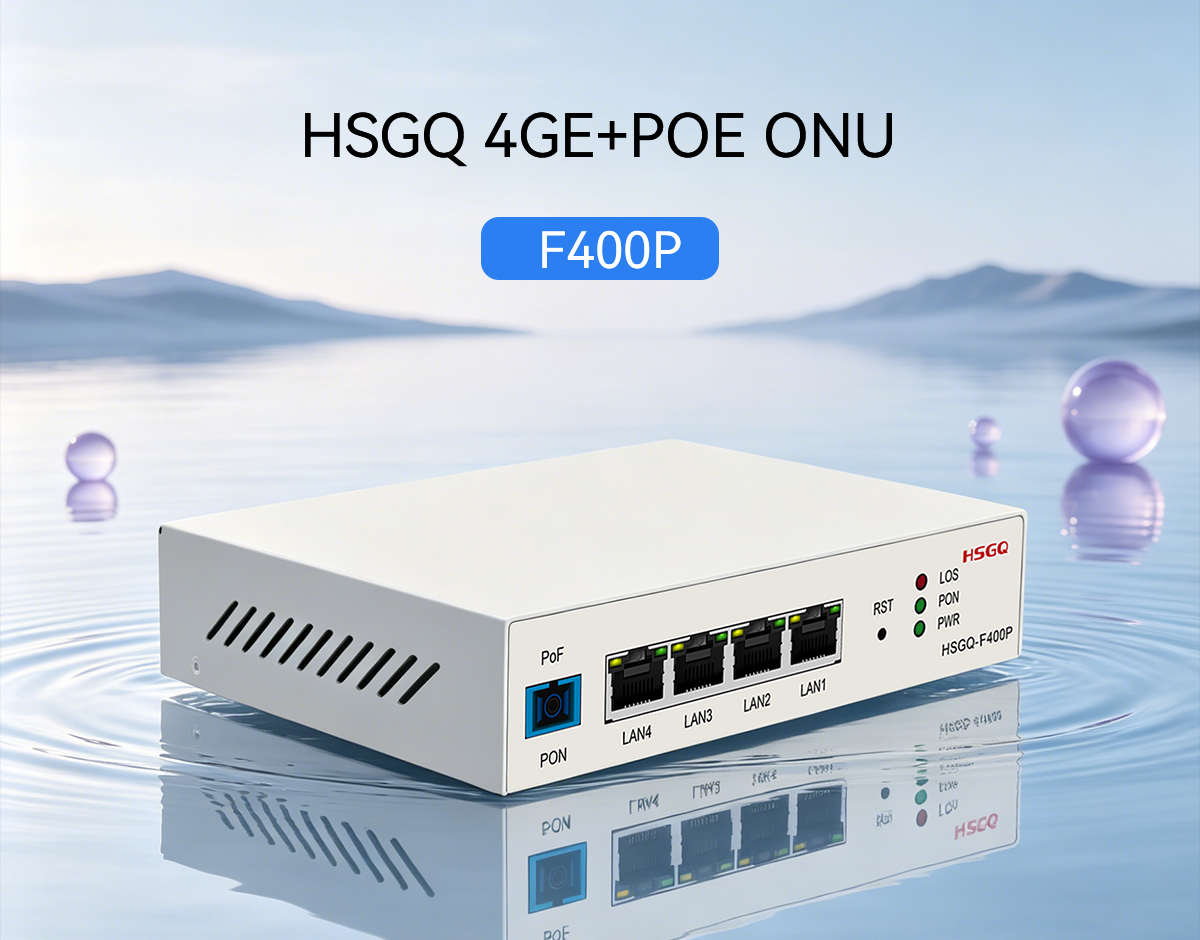
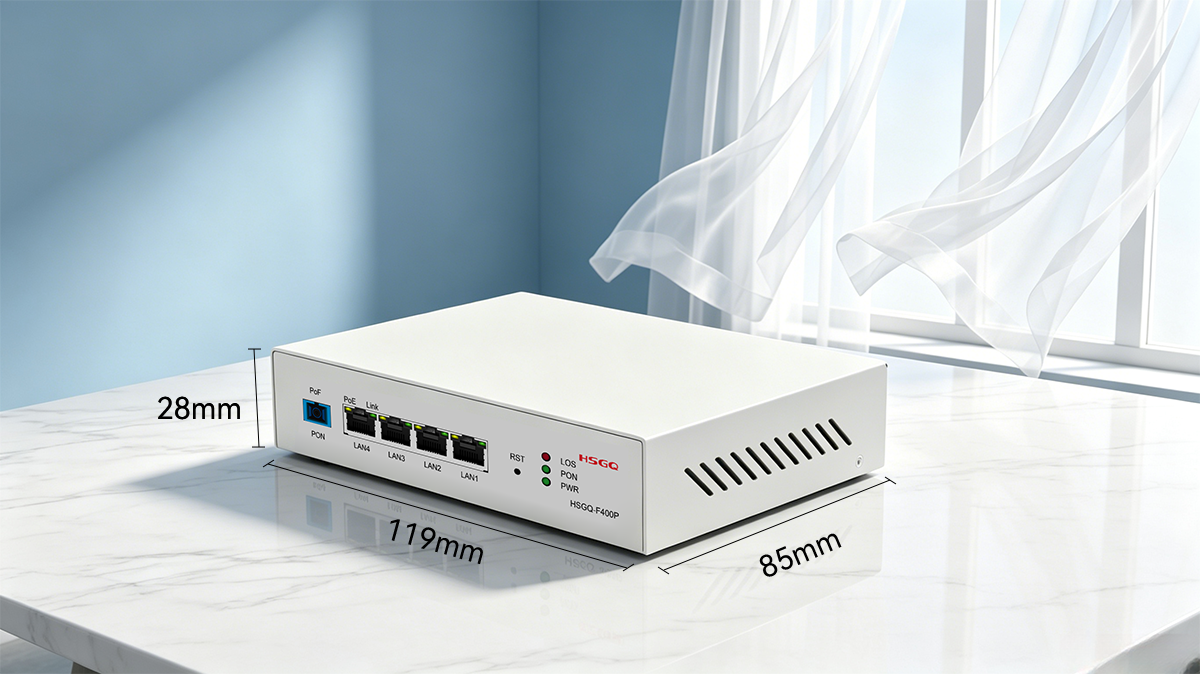
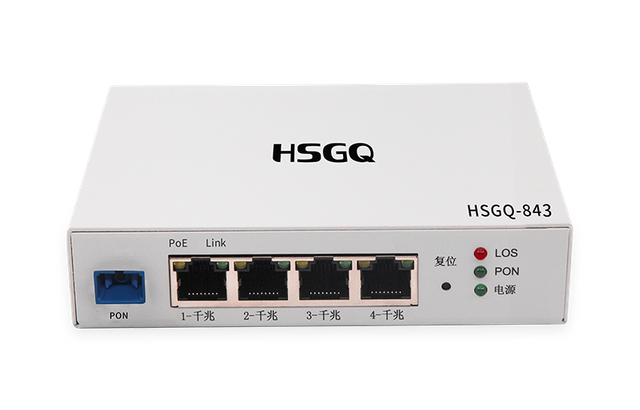
Designed for home networks, small businesses, hotels, and surveillance applications, the HSGQ-F400P combines fiber access, centralized PoF power, Gigabit Ethernet, and PoE output in one compact ONU.
HSGQ-F400P
| Quantity: | |
|---|---|
HSGQ-F400P is a 4-port PoF ONU for home and small business networks. It provides one GPON/EPON adaptive SC PON port and four Gigabit Ethernet ports for high-speed access. The PON port supports optical-electric hybrid cable access, while the RJ45 ports provide PoE/PoE+ output for compatible terminal devices.
With downstream speeds of up to 2.5Gbps and upstream speeds of up to 1.25Gbps, the F400P can deliver network data and remote power through a centralized PoF architecture. It supports Plug and Play installation, OMCI remote configuration, and HSGQ PoF network solutions for homes, small offices, hotels, and surveillance networks.
User interface | 4*GE RJ45 Interface |
PON | EPON&GPON mode auto-adaptive Interface Mode: Optical Composite Cable (PoF) GPON: upstream 1.25Gbps/ downstream 2.5Gbps Optical receive power: -7dBm~-28dBm Transmitting light power: 0.5dBm~4dBm EPON: upstream 1. 25Gbps/downstream 1.25Gbps Optical receive power: -7dBm~ -27dBm Transmitting optical power: 0dBm~4dBm PoF input voltage: 48V-57V |
PoE Standard | IEEE 802.3af/at (PSE) |
PoE PowerSupply Type | End-span |
PoE Pin Assignment | 1/2(+), 3/6(-) |
PoE Power Output | 48~57V DC |
PoE Power | 30W max for each port, 120W max in total |
Sizes | 119*85*28mm |
Environmental | Working temperature: -30°C~70°C Operating humidity: 0%~85% (non-condensing) Storage temperature: -40℃~80℃ Storage humidity: 5%~95% (non-condensing) |
Input Voltage | PoF: 48V-57V DC: 48V-57V |
Power Consumption | <130W |
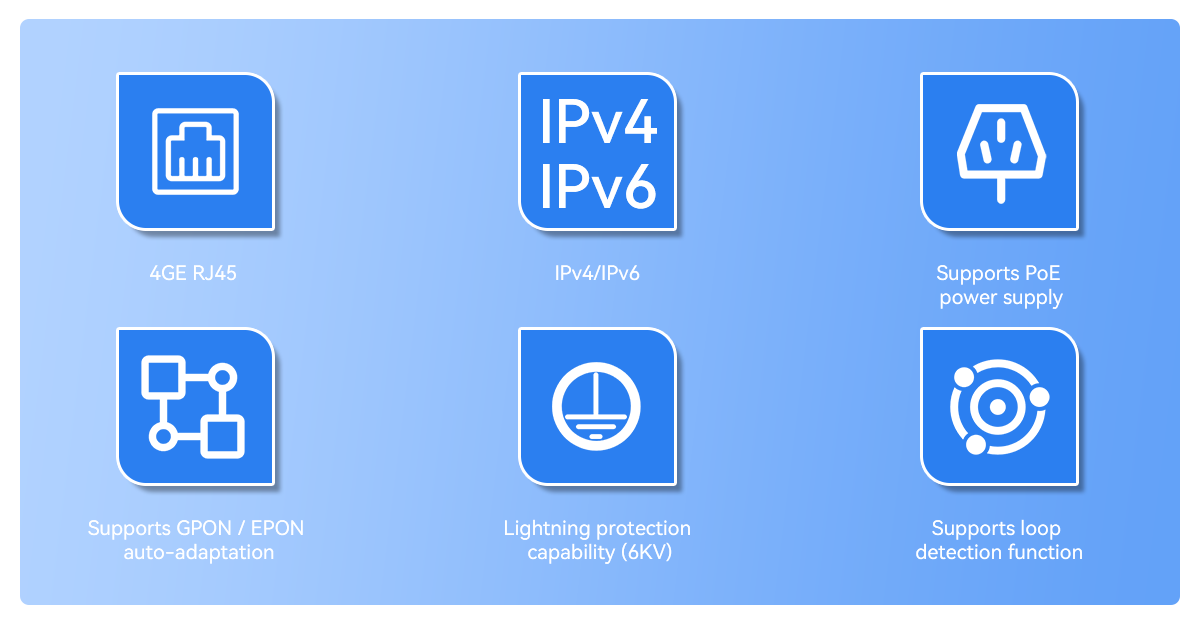
The F400P supports GPON and EPON mode auto-adaptation, allowing it to connect with compatible PON access networks. Its four GE RJ45 interfaces provide local Ethernet access for multiple devices, while IPv4 and IPv6 support helps the ONU integrate into different network environments.
The device also supports line loopback detection for user-side Ethernet interfaces. A 6 kV lightning protection capability provides additional protection for suitable installations, while actual surge protection depends on the grounding system, cable design, and site conditions.
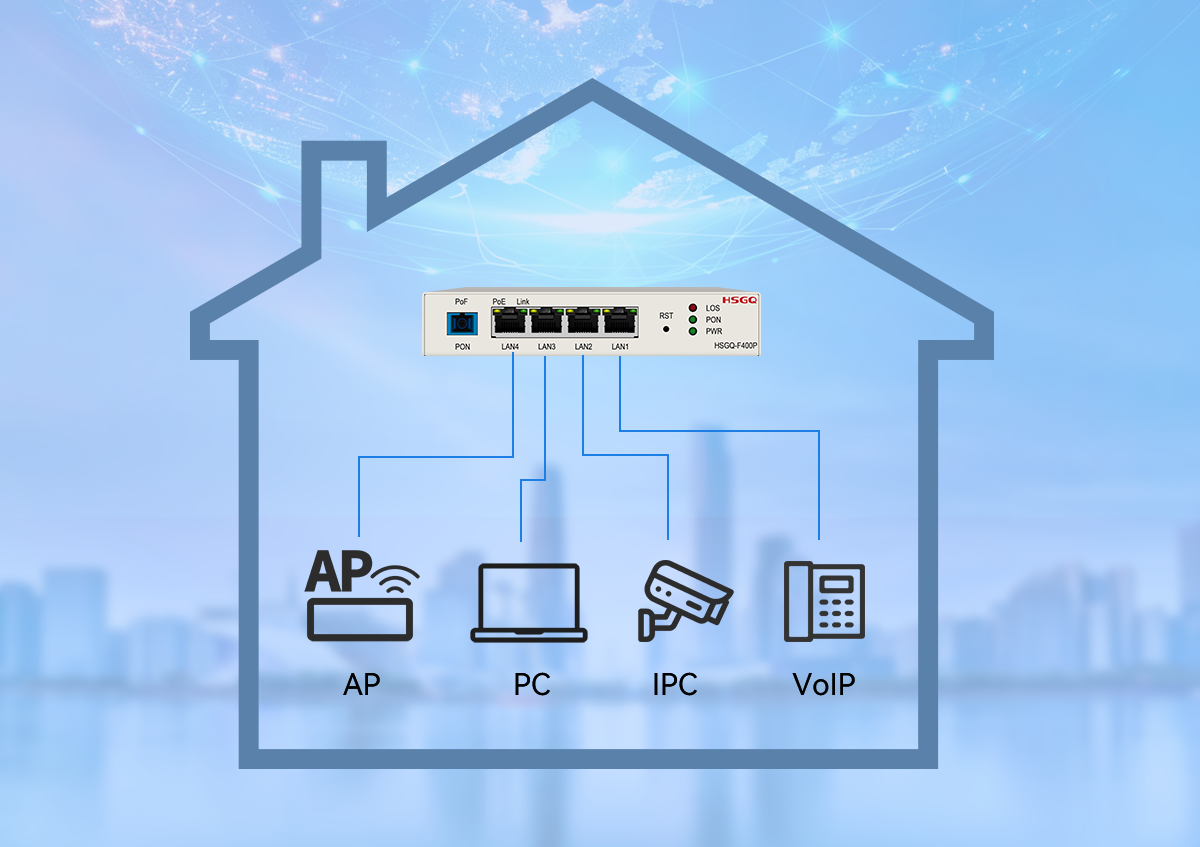
The F400P is designed to act as a local network access point for homes, small offices, and other compact indoor networks. One PoF connection from the upstream network can deliver data and power to the ONU, while the four downstream Ethernet ports connect local devices such as wireless access points, computers, IP cameras, and VoIP phones.
This layout helps organize multiple wired services around one compact PoF ONU and reduces the need for separate power adapters at compatible remote endpoints.
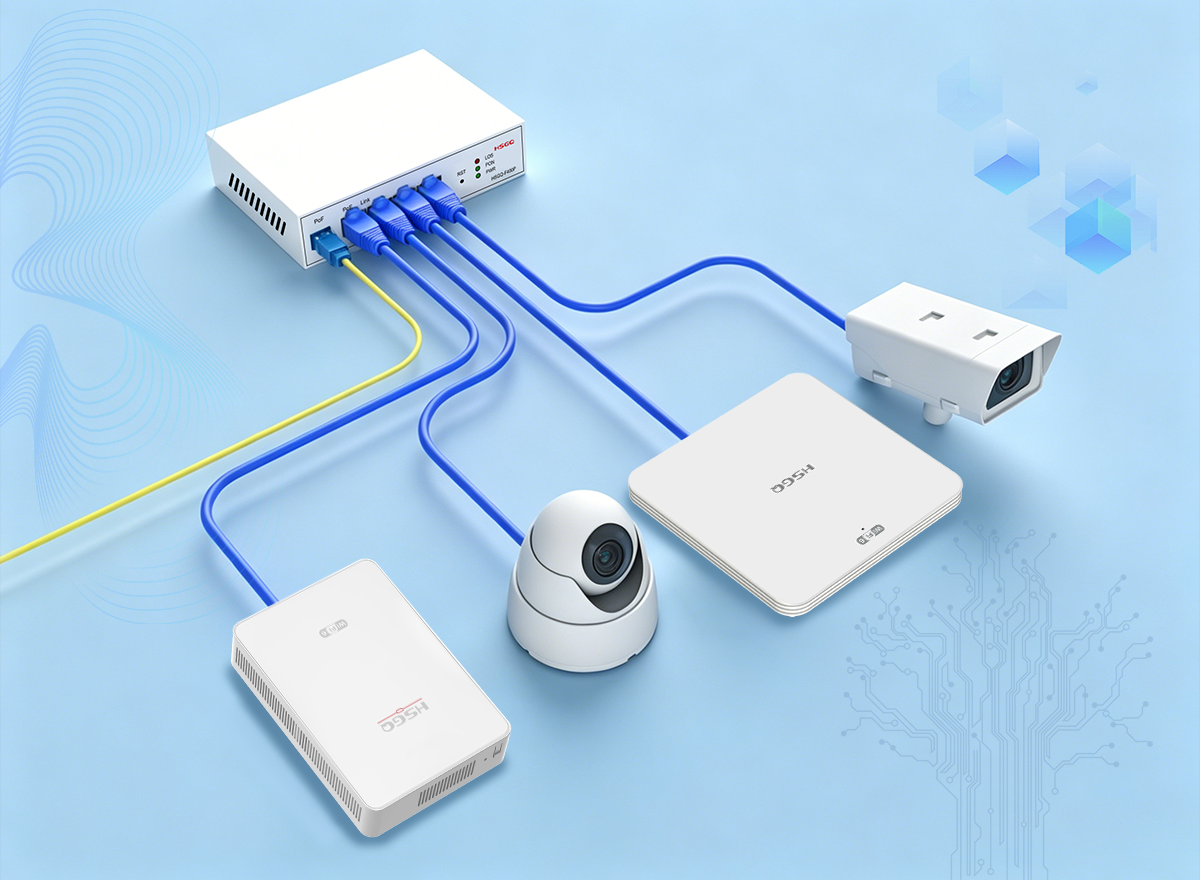
Each GE RJ45 port supports IEEE 802.3af/at PoE/PoE+ power output. The maximum output is up to 30W per port, with a total PoE power budget of up to 120W for the unit.
The F400P can supply power to compatible devices such as IP cameras, wireless access points, and IP phones through Ethernet cables. The PoE function identifies connected powered devices and provides power according to the device requirements. Before deployment, confirm the power demand of each terminal and the total load across all four ports.
The compact housing allows the F400P to be installed in home network cabinets, office distribution points, hotel rooms, and other space-limited locations. Its white enclosure is suitable for indoor environments where the network device needs to remain easy to access without taking up excessive installation space.
The ventilation openings support heat dissipation during operation. The device should be installed in a dry, ventilated location and kept away from water, excessive dust, and direct sources of heat.
The F400P can be used in different network environments where fiber access, centralized power, and multiple Ethernet connections are required. Typical applications include:
Home broadband and smart home networks
Small office and commercial networks
Hotel rooms and apartment units
IP camera and security monitoring systems
Wireless access point deployment
VoIP phone and other powered terminal access
For larger deployments, the F400P can be connected to a compatible PoF optical router to create a centralized data and power distribution structure.
The F400P adopts a point-to-multipoint network topology to collect and aggregate dispersed Ethernet services. It provides standard RJ45 Gigabit Ethernet interfaces on the user side for connecting multiple local devices.
The ONU supports VLAN pass-through, VLAN tagging, VLAN translation, Qin-Q, trunk, and multicast pass-through functions. These features support different service separation and transmission requirements in compatible network environments.
IGMP multicast support helps use broadband resources more efficiently when delivering multicast services. The F400P also supports the IEEE 802.1Q VLAN protocol for network segmentation, service isolation, and traffic management.
The F400P provides remote management through the OLT and supports local web and Telnet management. Cloud management is also available in compatible deployment environments, helping administrators configure and maintain the device more efficiently.
Line loopback detection helps identify abnormal conditions on user-side Ethernet interfaces. Broadcast storm suppression helps reduce the impact of excessive broadcast traffic on connected network segments.
The ONU supports IEEE 802.3x full-duplex flow control for more stable traffic handling. It also supports IEEE 802.1p and CoS protocols, as well as WR and SP queue scheduling algorithms for traffic classification and priority management.
Port speed limiting allows administrators to apply different bandwidth limits to connected user ports or terminal devices. This can help manage shared network resources in multi-user environments.
The F400P supports IPv4 and IPv6 network environments. Its PON interface supports PoF access through an optical-electric hybrid cable, allowing compatible network architectures to transmit data and remote power through the same connection.
The F400P supports an operating temperature range of -30°C to 70°C. For stable operation, the device should be installed with sufficient ventilation and protected from moisture, dust, and physical damage.
The F400P supports up to 30W per PoE port and up to 120W total PoE output. When connecting several powered devices, calculate the required power for each endpoint before installation.
The planning process should consider:
The PoE standard supported by each connected device
The maximum power demand of each camera, AP, or IP phone
The combined power consumption across all four ports
Ethernet cable length and quality
The available power from the upstream PoF system
Power demand during peak operation
A terminal may support PoE/PoE+ while requiring less than the maximum available output. Actual power delivery depends on the connected device, cable conditions, and total system load.
Before bulk deployment, confirm the following requirements:
The upstream OLT supports the required GPON or EPON mode.
The PON authentication and management method are compatible.
The optical-electric hybrid cable is suitable for the planned PoF connection.
The optical budget covers the planned transmission distance.
The connected devices support the required Ethernet and PoE standards.
VLAN, Qin-Q, trunk, multicast, and QoS requirements have been confirmed.
The total PoE demand remains within the available power budget.
Third-party OLT and terminal compatibility has been verified through sample testing.
The F400P can be used together with other products in the HSGQ PoF ONU product range, depending on the required network topology and terminal interfaces.
A sample installation is recommended before deploying the F400P across a larger project. The test should verify:
GPON or EPON registration
Optical link stability
Data forwarding and Internet access
PoE output on each connected port
VLAN, Qin-Q, trunk, and multicast functions
Port speed limits and QoS scheduling
Remote OLT, web, Telnet, or cloud management
Operation of connected cameras, APs, IP phones, and other terminals
For PoF transmission distance, optical loss, power load, and network topology planning, refer to the HSGQ PoF network planning guide.
The F400P is a PoF ONU with four Gigabit Ethernet ports and PoE/PoE+ power output. It receives the PON service and PoF power from the upstream network, then provides Ethernet access and power to compatible downstream devices.
Yes. It is suitable for home broadband, smart home devices, wireless access points, IP cameras, and VoIP phones when the upstream OLT and PoF architecture are compatible.
The F400P provides four PoE-enabled Ethernet ports. Each port supports up to 30W, while the total PoE output is limited to 120W. The actual number of powered devices depends on their individual power requirements and the total system load.
When PoF input is used, the F400P receives power through the optical-electric hybrid cable from the upstream PoF system. The complete installation must still provide a compatible central power source and remain within the required optical and power budgets.
Compatibility depends on the GPON or EPON mode, authentication method, optical levels, management functions, VLAN configuration, and firmware behavior. Third-party OLT compatibility should be verified through sample testing before bulk installation.
Yes. Non-PoE Ethernet devices can use the RJ45 interfaces for data access. The connected device and port should still be checked to ensure that the power output method is compatible with the terminal requirements.
No. The maximum output is limited to 30W per port, with a total power budget of up to 120W across the four ports. Power planning should consider both the per-port limit and the total system load.
Need one ONU for fiber access, PoE-powered devices, and multiple Gigabit Ethernet connections? Share your endpoint quantity, PoE power demand, and OLT environment with our team.
4 GE Ports | GPON/EPON Auto-Adaptation | PoE/PoE+ up to 30W per Port