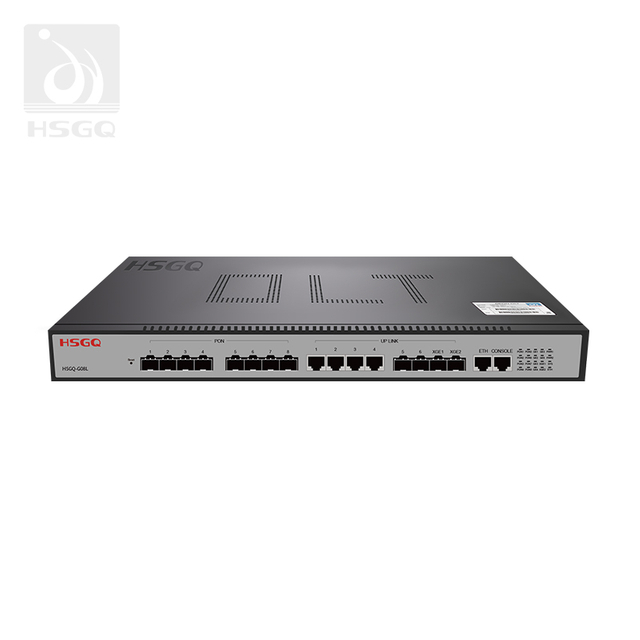
HSGQ-F32R
| Quantity: | |
|---|---|
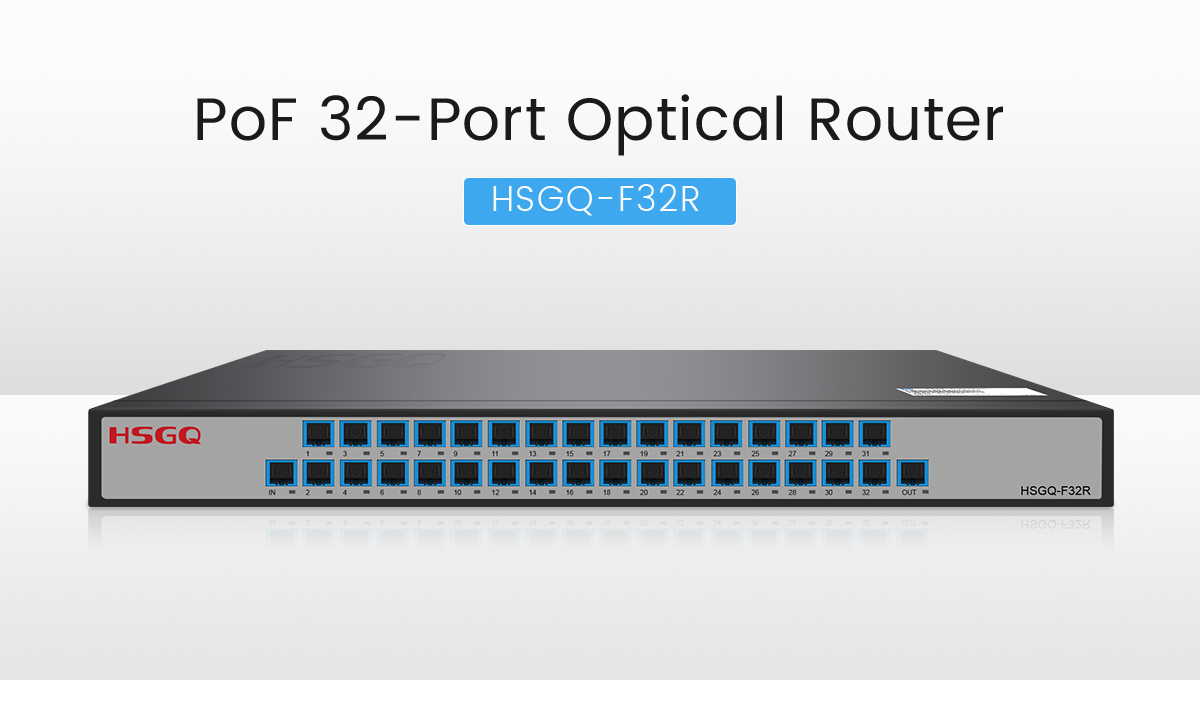
HSGQ-F32R is a 32-port PoF optical router designed for GPON and EPON ONU networks. It integrates a 1+32-channel optical distribution unit with a 32-channel 48V power supply unit, providing centralized data transmission and remote power delivery through an optical-electric hybrid cable. It can be deployed as part of complete PoF solutions for offices, hotels, campuses, and video surveillance networks.
Key advantages include:
32 PoF SC output ports for multi-branch ONU deployment
One PON input and one PON cascade output
GPON and EPON auto-adaptation
Data and power transmission through optical-electric hybrid cable
Transmission distance of up to 300 meters
Support for secondary cascade
Up to 80W PoF power output per port
Up to 800W total power output
Suitable for parks, hotels, and video surveillance networks
Item | HSGQ-32R |
User Interface | 32*PoF SC (Out) |
1*PON (Out) | |
1*PON (In) | |
PON | GPON and EPON mode self-adaptation Interface mode: Optical-electric composite cable |
GPON: upstream 1.25Gbps /downstream 2.5Gbps Optical Power: -7dBm~-28dBm | |
EPON: upstream 1.25Gbps /downstream 1.25Gbps Transmit optical power: 0~4dBm Optical Power: -7dBm~-27dBm | |
Size | 445mm x 310mm x 44mm |
Environment | Operating temperature: -10°C~50°C |
Operating humidity: 0%~85% (non-condensing) | |
Storage temperature: -40°C~80°C | |
Storage temperature: 5%~95% (non-condensing) | |
Power Supply | AC: 100-240V 50/60Hz |
Power Consumption | <800W |
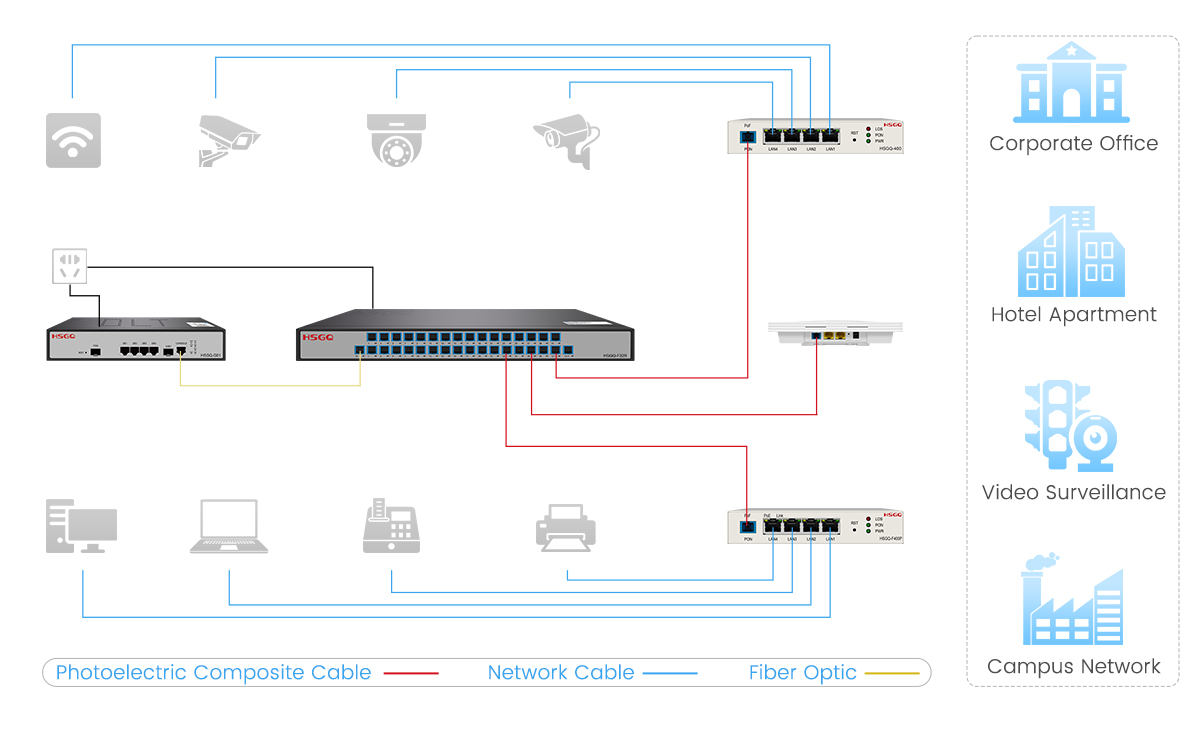
With GPON/EPON auto-adaptation, this PoF router can connect multiple remote ONU branches through its optical distribution ports. Fiber optic, network cable, and optical-electric composite cable can be selected according to different terminal requirements.
The flexible PoF network architecture is suitable for corporate offices, hotel apartments, video surveillance systems, and campus networks.
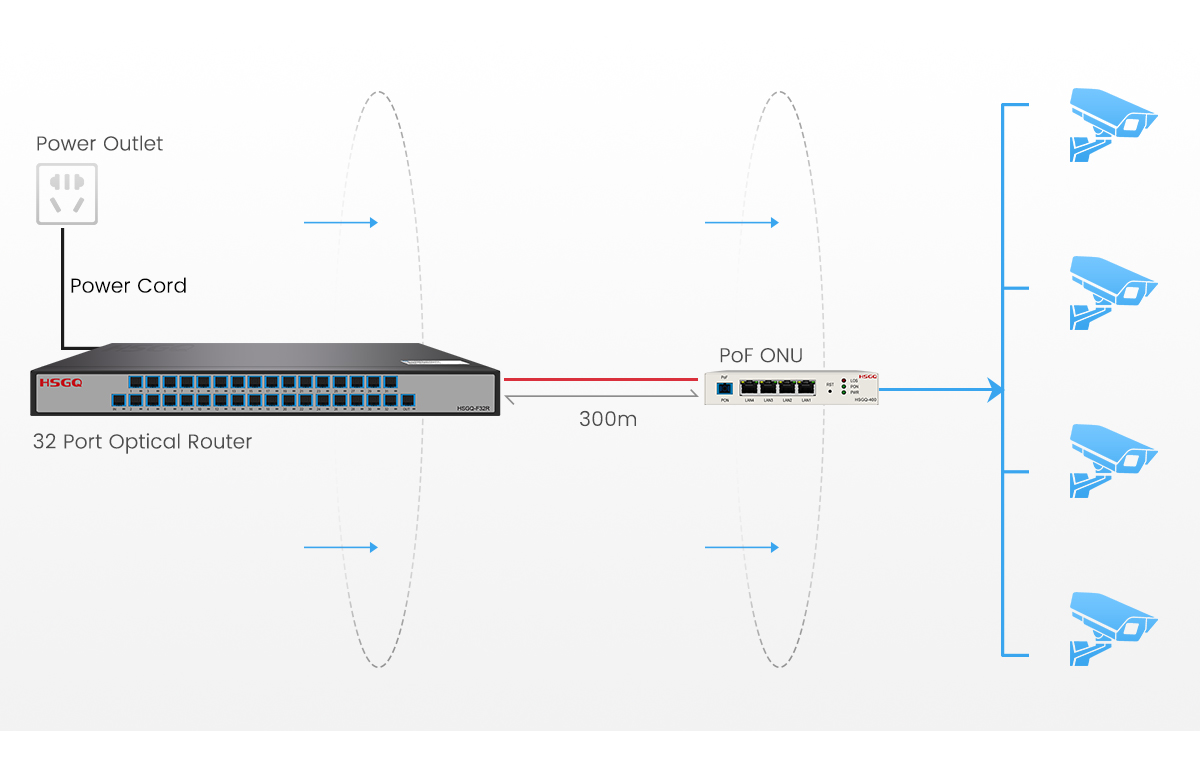
Only one power connection is required at the central equipment side. As a PoF optical gateway, the F32R delivers data and power to remote PoF ONUs through an optical-electric hybrid cable over distances of up to 300 meters.
A PoF ONU terminal or four-port PoF ONU can then provide network access for cameras and other terminal devices without a separate local power adapter.
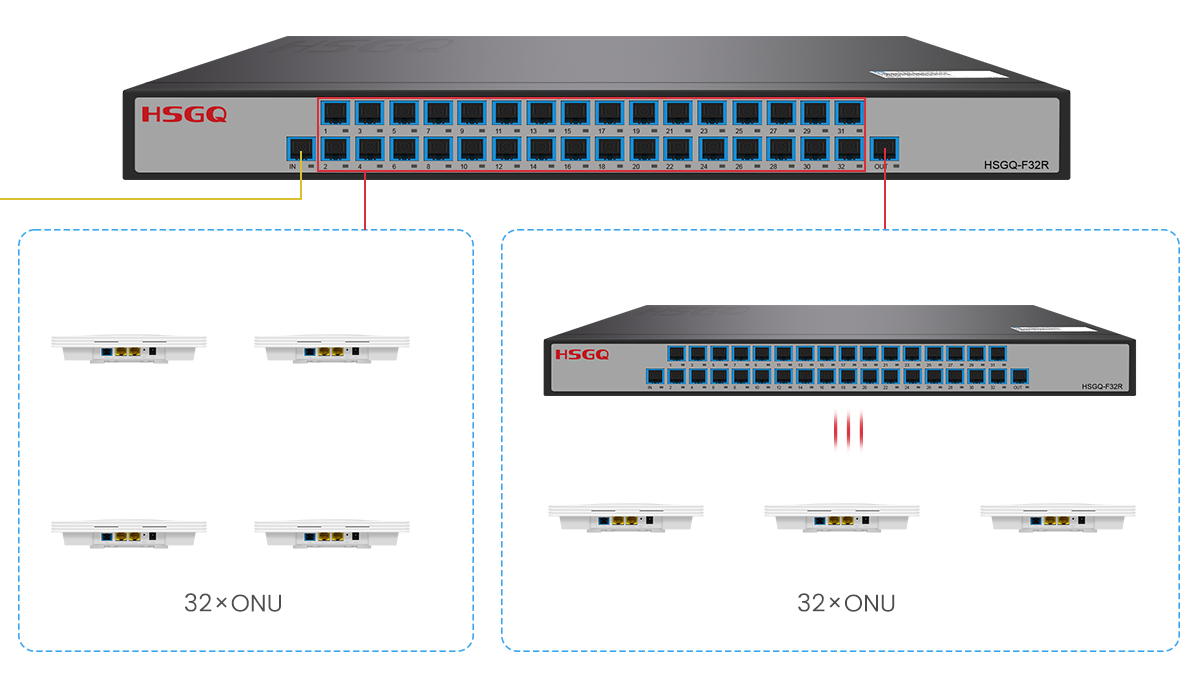
After connecting to the OLT, the F32R can use its PON cascade output to connect to another F32R or a compatible downstream distribution device. This PoF router cascade extends the ONU connection structure and supports additional remote terminals without changing the main upstream layout.
The cascade design should be planned according to cable distance, optical loss, bandwidth, and total power load.
When planning a cascaded PoF network, consider cable length, optical budget, and total power capacity. HSGQ’s PoF network planning guide provides practical guidance for these factors.
The HSGQ-F32R combines optical routing and centralized PoF power distribution in one device. Connected to an upstream OLT, it sends the PON signal and power to compatible remote ONUs through optical-electric hybrid cable, helping simplify cabling in distributed all-optical networks.
With GPON/EPON auto-adaptation and multi-branch PoF output, the F32R can be integrated into different PON access environments. It is suitable for projects where remote ONUs are distributed across multiple rooms, floors, or buildings, including parks, hotels, and video surveillance networks.
Compatible remote ONUs can receive network data and power through the same PoF hybrid cable. With a transmission distance of up to 300 meters under suitable conditions, the F32R helps reduce the need for local power outlets and separate power adapters at remote terminals.
After connecting to the OLT, the F32R can use its PON output for secondary cascade and extend the network to a downstream distribution level. The maximum supported cascade is two levels. Cascade planning should consider cable distance, optical loss, endpoint power demand, and total network load.
The F32R is compatible with other systems, platforms, and network products when the PON mode, optical interface, and PoF requirements are properly matched. Before using third-party ONUs, check the GPON/EPON mode, connector type, optical budget, management requirements, and power demand.
The product is tested for vibration, network load, and PoF load to support reliable operation in multi-branch PoF network deployments.
In a park or campus network, remote buildings and facilities may be spread across a wide area. Running both fiber and separate power cables to every endpoint can make deployment more complicated.
The F32R provides a centralized PoF distribution point for multiple remote branches. It can help connect compatible ONUs and terminals across different zones while keeping the network architecture organized around the equipment room.
Hotels and apartment buildings often require network access in rooms, corridors, service areas, and shared facilities. A centralized PoF design can reduce the need for local power adapters at each remote ONU location.
The F32R can be integrated into a structured fiber access system where different PoF outputs serve different floors, rooms, or building sections. The final endpoint may provide Ethernet, Wi-Fi, voice, or PoE services depending on the selected ONU or terminal.
Surveillance cameras and related network devices are often installed in locations where power access is limited or difficult to expand. A PoF architecture can provide both network connectivity and remote power through a hybrid cable.
The F32R is suitable for centralized distribution in video surveillance projects that use compatible PoF terminals. Project designers should match the power output of each port with the actual requirement of the connected camera, ONU, access point, or PoE device.
The F32R can also be used as part of a broader HSGQ PoF solution. In this type of architecture, the OLT provides the upstream PON access, the F32R distributes the signal and power, and compatible remote terminals provide user-side network services.
This division of functions makes it easier to plan the network by layer:
OLT for upstream PON access and network control
F32R for centralized PoF distribution
Hybrid cable for data and power transmission
Remote ONU or terminal for local Ethernet, Wi-Fi, or PoE access
The F32R should be selected as part of a complete PON and PoF system rather than as an isolated router. Before ordering, confirm the following items:
Whether the upstream OLT uses GPON or EPON
Whether the remote ONU supports the selected PON mode
Whether the ONU accepts PoF optical-electric hybrid cable input
Whether the connector type matches the F32R PoF SC output
Whether the optical power budget covers the planned cable distance
Whether the endpoint power demand is within the port limit
Whether the total project load is within the available PoF power
Whether the installation environment remains within the operating temperature range
Whether a cascade is required and how many distribution levels are planned
Whether the OLT and ONU management requirements have been tested
For third-party equipment, interoperability should be verified on a case-by-case basis. Matching the same GPON or EPON label does not automatically guarantee full compatibility. Firmware behavior, ONU authentication, OMCI or OAM functions, VLAN configuration, optical levels, and management features may also affect deployment.
For projects with multiple ONU models or long cable runs, sample testing before bulk installation is recommended. This allows the installer to verify registration, data forwarding, PoF output, optical performance, and endpoint stability under the intended load.
The F32R uses a gold-plated module PCB design and a low-power integrated circuit architecture. These design choices support stable operation in a multi-port PoF distribution environment.
The product page also lists vibration testing, network load testing, and PoF load testing as part of the product evaluation process. These checks are relevant to projects where the equipment must handle multiple active branches and sustained power delivery.
The 44 mm chassis height supports installation in structured equipment environments. The operating temperature range is -10°C to 50°C, while the installation location should also provide suitable ventilation and protection from moisture, dust, and unauthorized access.
For outdoor or semi-outdoor deployments, the F32R should be installed inside a suitable protected cabinet or equipment room unless the project specification confirms additional environmental protection.
No. The F32R is used with an upstream PON or OLT connection. The OLT provides the upstream access function, while the F32R distributes the PON signal and PoF power to remote branches.
The F32R provides 32 PoF SC output ports, so it can support up to 32 direct PoF output branches. The final number of active endpoints depends on the network topology, port allocation, endpoint power demand, optical budget, and cascade design.
No. The F32R is a centralized PoF distribution device. Wi-Fi service is provided by a compatible Wi-Fi ONU, optical access point, or other wireless terminal connected at the remote end.
It may be possible when the OLT mode, ONU interface, PoF input, optical parameters, and management requirements are compatible. Third-party ONU compatibility should be confirmed through technical documentation or sample testing before bulk deployment.
The F32R can be considered for an all-optical or FTTR-style architecture when the selected remote ONUs, optical access points, hybrid cables, and upstream PON equipment support the required topology. The complete design should be checked for optical loss, power demand, and endpoint compatibility.
The actual distance depends on the hybrid cable, optical attenuation, connector loss, power load, number of active ports, and installation conditions. The 300 m figure should be treated as a maximum reference under suitable conditions rather than a guaranteed distance for every cable and endpoint combination.
The listed operating temperature is -10°C to 50°C, but the product specifications do not indicate a weatherproof or IP-rated enclosure. Outdoor installation should use a suitable protective cabinet or equipment room unless additional environmental protection has been confirmed.
A project inquiry should include the required PON mode, OLT model, number of remote ONUs, maximum cable distance, endpoint power requirements, connector type, installation environment, and whether secondary cascade is needed. This information helps determine the correct PoF configuration and deployment plan.
Need a 32-port PoF optical router for a GPON/EPON project? Share your OLT model, ONU quantity, transmission distance, power requirements, and deployment environment with our team.