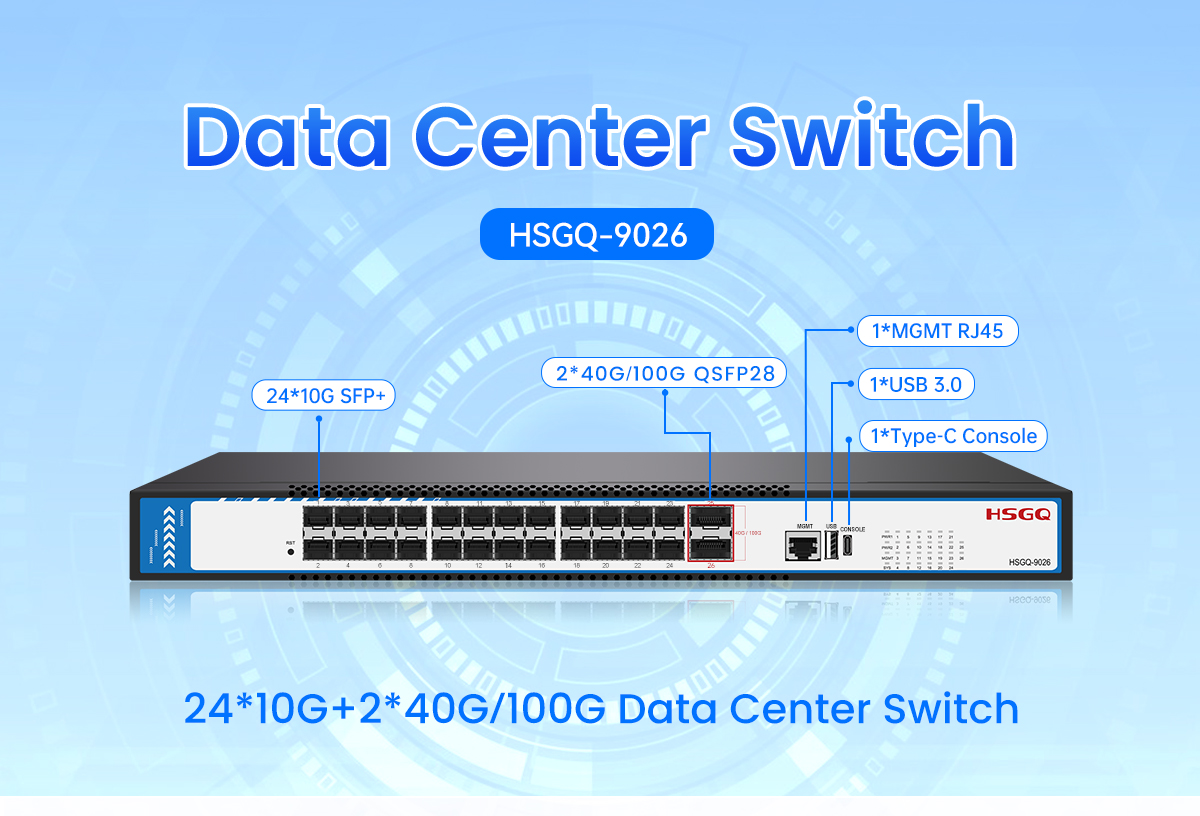
HSGQ-9026 is a next-generation high-performance data center switch designed for high-performance cloud computing, data centers, and high-end campus networks. It features 24*SFP+ 10 Gigabit fiber optic module slots, 2*40G /100G QSFP28 ports, 1*MGMT out-of-band management RJ45 interface, 1*Type-C Console management interface, and 1*USB 3.0 interface. It supports IPv4 / IPv6 dual-stack, static routing, DHCP Server, DHCP Relay, and DHCP Snooping. It supports Layer 3 routing protocols, including RIP, RIPng, OSPFv2/v3, BGP-4 dynamic routing, and VRRP virtual routing redundancy protocols. It provides comprehensive security policies, robust QoS policies, and rich VLAN functionality, making it easy to manage and maintain, and meeting the networking needs of enterprise networks, campus network aggregation, carrier edge computing, and other application scenarios.
Dual-power supply redundancy design
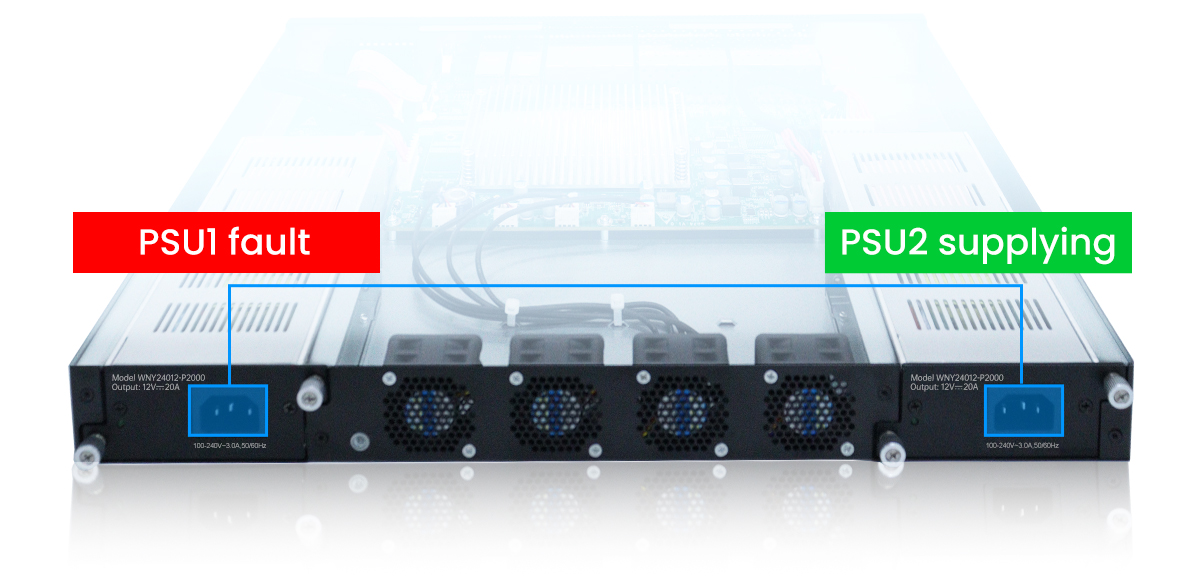
Two hot-swappable AC 100-240V power supplies with 1+1 redundancy. Upon failure, seamless switchover ensures uninterrupted stable operation.
Front and rear ventilation design
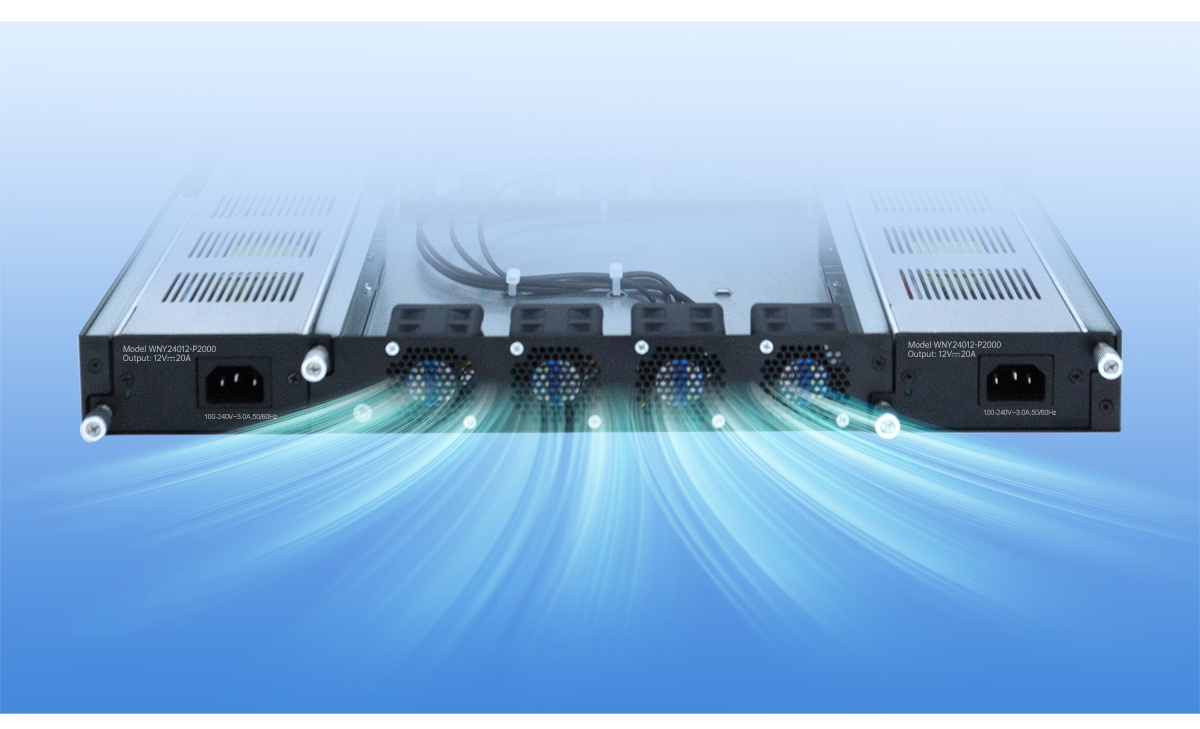
Front and rear ventilation design, with 4 smart fans that can adjust their speed intelligently based on the temperature sensors.
Hardware Design
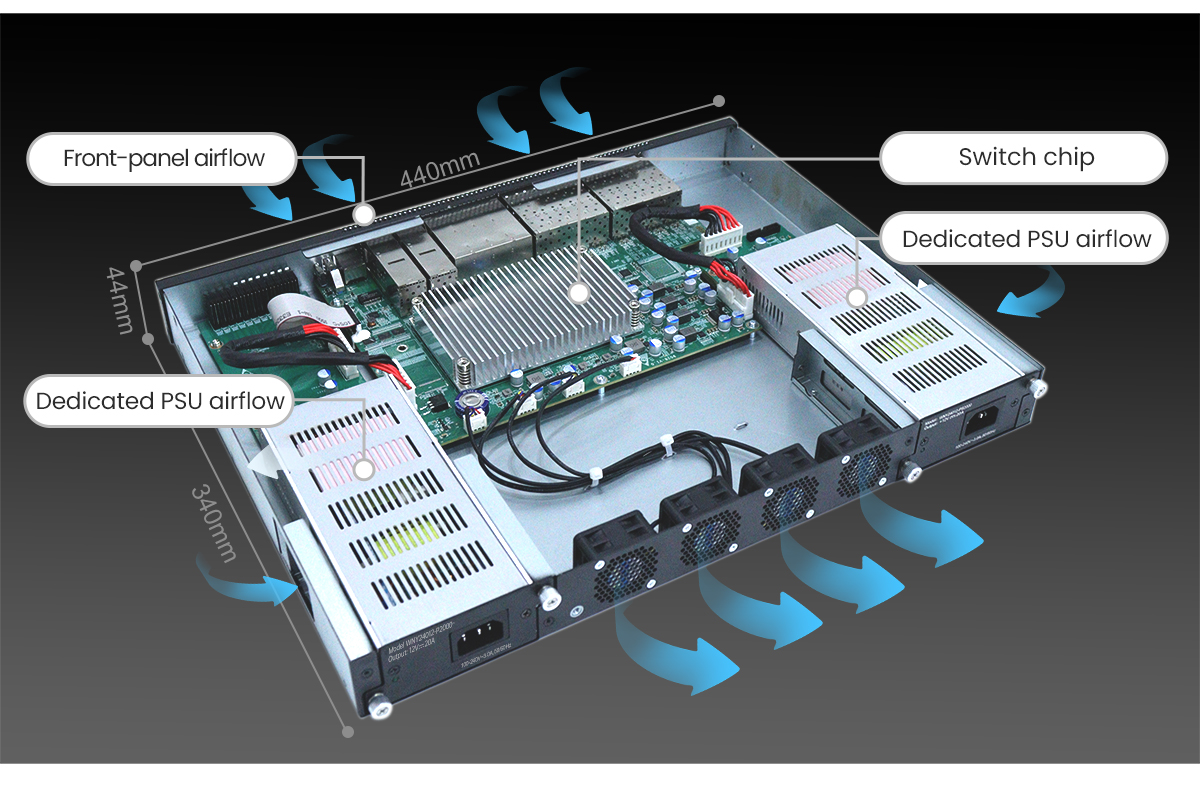
Data-center & server-grade hardware, optimized layout.
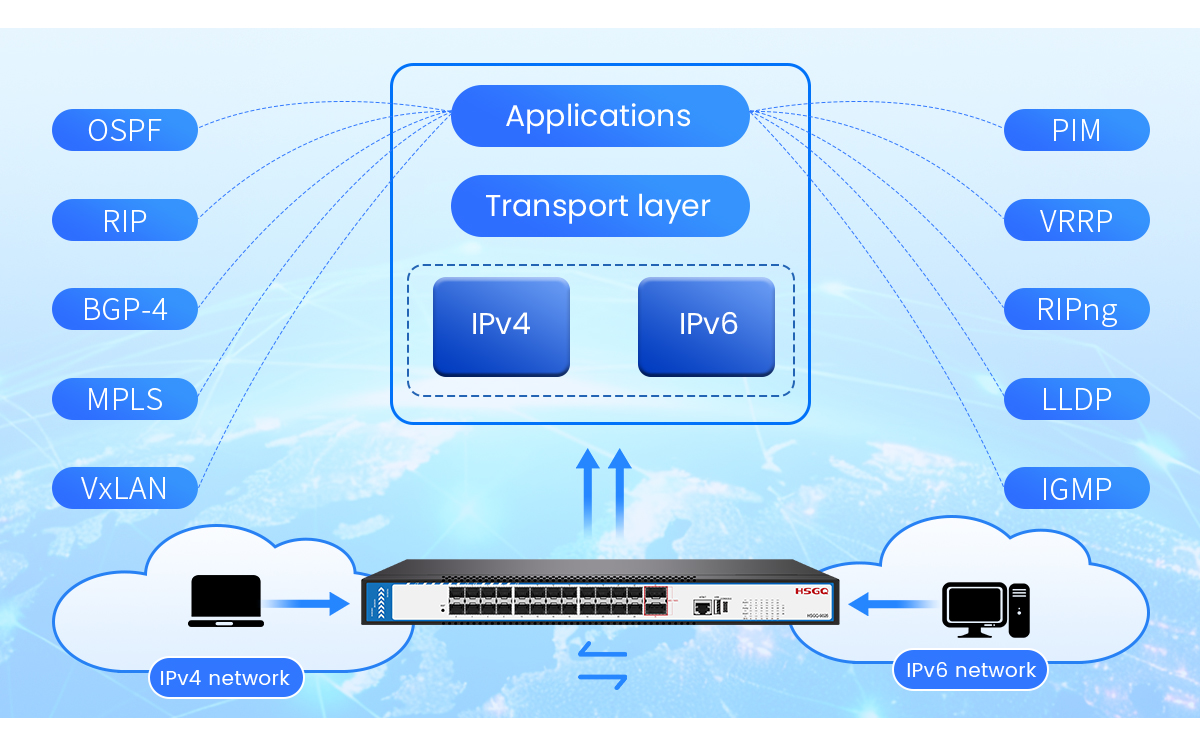
IPv4/IPv6 dual-stack
Park Network Solution – Core Switch
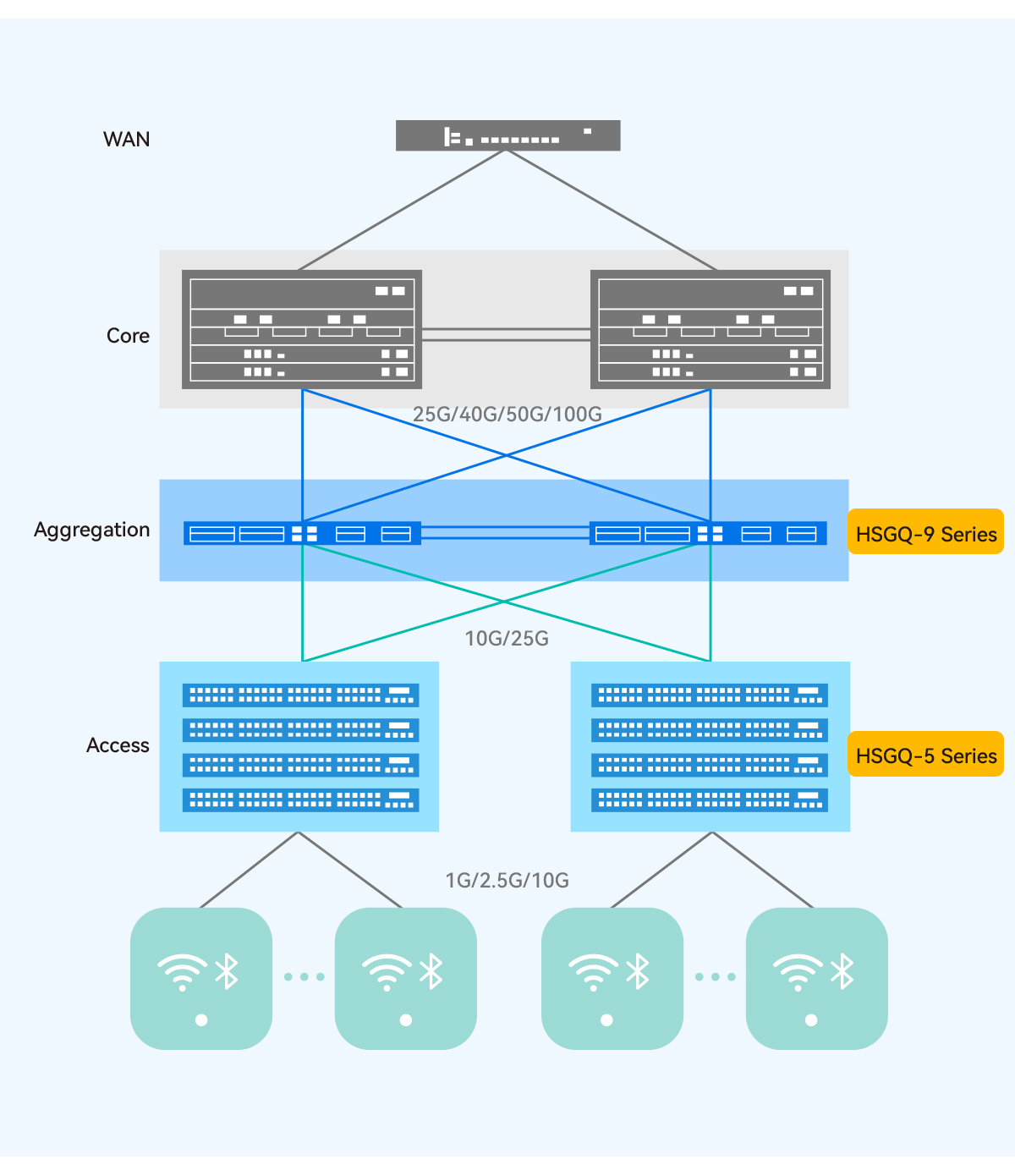
HSGQ-90 series switches offer 10G downstream and 100G upstream connectivity, serving as either an aggregation or core layer in a campus network topology.
M-LAG (Multichassis Link Aggregation Group) has the advantages of increasing bandwidth, improving link reliability, and load balancing, improving link reliability from the single board level to the device level. This horizontal virtualization technology significantly simplifies network topology.
| Items | HSGQ-9026 |
| Network Standards | IEEE802.3, IEEE802.3u, IEEE 802.3ab, IEEE802.3z, IEEE802.3ae, IEEE 802.3bq, IEEE 802.3ba , IEEE802.3x, IEEE802.1x, IEEE802.1q, IEEE802.1p, IEEE802.1d, IEEE802.1w, IEEE802.1s, IEEE802.3ad , IEEE 802.1a |
| Interface | 24*SFP+ 10 Gigabit Fiber Optic Module Slots 2*40G/100G QSFP28-port 1*MGMT out-of-band management RJ45 interface 1*Type-C Console interface (115200,8,N,1) 1*USB 3.0 port |
| LED indicator light | PWR 1 (green), PWR 2 (green), MGMT (green), SYS (green), Port LED (green) |
| MAC Address Table | 112 K |
| Jumbo Frame | 12K Byte |
| Packet buffer | 8MB |
| Forwarding mode | Store-and-forward |
| Switching Capacity | 880 Gbps |
| Packet Forwarding Rate | 660 Mpps |
| Power Supply | 240W |
| Power Input | Standard configuration includes one hot-swappable AC100-240V power supply, 50Hz ±10%. Optional two hot-swappable AC100-240V power supplies, 50Hz ±10% |
| Fan | Built-in 4 smart fans, providing front and rear ventilation |
| Static electricity standards | Contact ±6KV, air ±8KV |
| Working Environment | Operating Temperature: -10℃ ~ 45℃; |
| Storage Temperature: -40℃ ~ 70℃; | |
| Operating Humidity: 10% ~ 90%, non-condensing | |
| Storage Humidity: 5% ~ 90%, non-condensing | |
| MTBF | 50,000 hours |
| Dimensions (L*W*H) | 440mm*340mm*44mm (W*D*H) |
24* (SFP+) 10 Gigabit optical ports + 2*40G/100G QSFP28 ports + 1*Type-C Console interface+1*MGMT out-of-band management port + 1*USB 3.0 interface;
It adopts an ARM dual-core processor and supports a switching capacity of up to 880Gbps, meeting the requirements of data centers for high performance, high capacity, high density and scalability;
Standard configuration includes one hot-swappable AC100-240V power supply, two hot-swappable AC100-240V power supplies are optional.
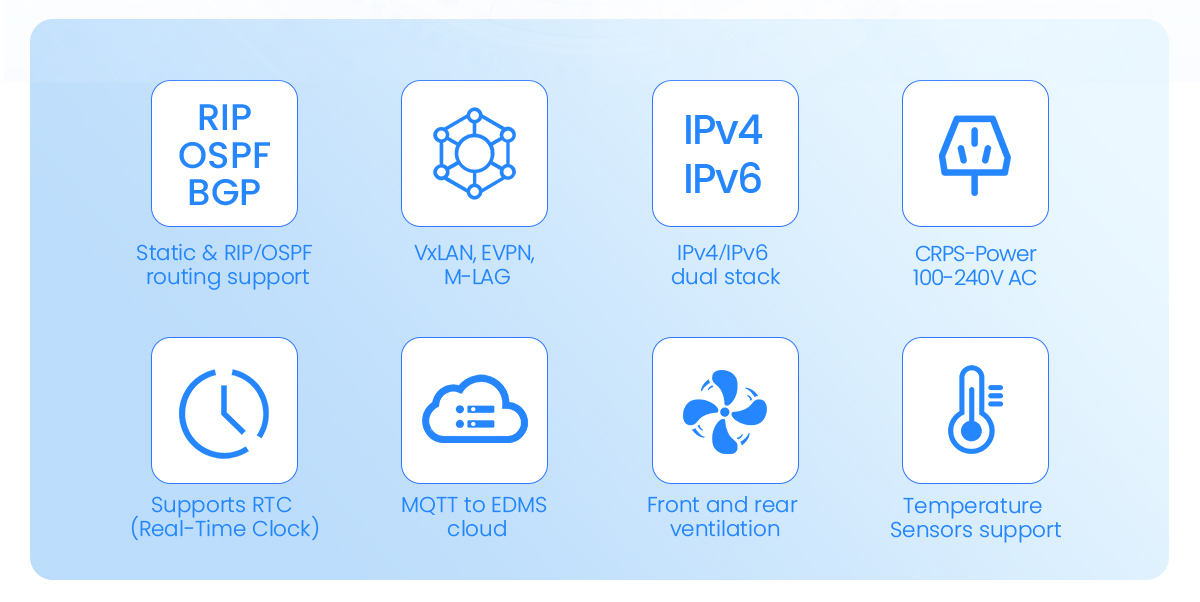
It supports RTC real-time clock function to meet the time continuity requirements of industrial equipment;
Standard data center front and rear cooling airflow design;
Supports temperature sensor and smart fan; built-in 4*smart fans;
The intelligent fan management system supports automatic fan speed adjustment, effectively reducing fan speed, noise, and extending fan life;
Supports STP/RSTP/MSTP link protection technologies and ERPS ring network protocol;
It supports two aggregation modes: static link aggregation and LACP dynamic link aggregation, which effectively increases link bandwidth and improves link reliability, while also enabling load balancing and link backup.
Supports IPv4 / IPv6 dual protocol stack, static routing, DHCP Server, DHCP Relay, and DHCP Snooping ;
Supports Layer 3 routing protocols, including RIP, RIPng, OSPFv2/v3, BGP-4 dynamic routing, and VRRP virtual route redundancy protocol;
It has loop detection capabilities and adopts an intelligent resolution mechanism to achieve intelligent network self-healing;
It supports Layer 2 and Layer 3 MPLS VPNs, and can build large-scale MPLS VPN core networks to meet the access needs of industry private network VPN users and enterprise network VPN users.
It supports a high-precision BFD bidirectional link detection mechanism, and through linkage with Layer 2 and Layer 3 protocols, it can achieve millisecond-level fault detection and service recovery, thereby enhancing the reliability of the network system.
Supports multiple management methods including Type-C Console, MGMT, Web CLI, Telnet, SSH, and SNMP (v1/v2c/v3);
Supports bilingual (Chinese and English) web interface management, making product debugging simpler and more efficient;
Supports MQTT protocol connection to EDMS cloud management platform, cloud platform supports local deployment and cloud deployment;
Supports full firmware version upgrades via HTTP, TFTP, and FTP transfer methods