Views: 0 Author: Site Editor Publish Time: 2026-04-29 Origin: Site
Why do modern networks need fewer cables but better performance? A PoE Switch solves this by sending power and data through one Ethernet cable. It supports cameras, access points, and phones while simplifying installation. In this article, you will learn how a poe switch 16 port, 10/100/1000m poe switch for ip camera, and cctv managed poe switch fit real projects.
A PoE Switch is a network switch that delivers Ethernet data and DC power through the same RJ45 cable, so one connection can both link a device to the LAN and keep it powered. That is why PoE switching has become a practical choice for modern access networks, especially where installers want to avoid separate adapters, extra conduit, and repeated electrical work. For commercial and security deployments, this approach improves installation efficiency and supports a cleaner network layout. HSGQ’s 16-port model reflects this role clearly: it offers 16 Gigabit PoE ports, supports IEEE 802.3af/at, and is designed for user access, convergence, and Ethernet access scenarios such as SMEs, hotels, schools, buildings, and industrial parks.
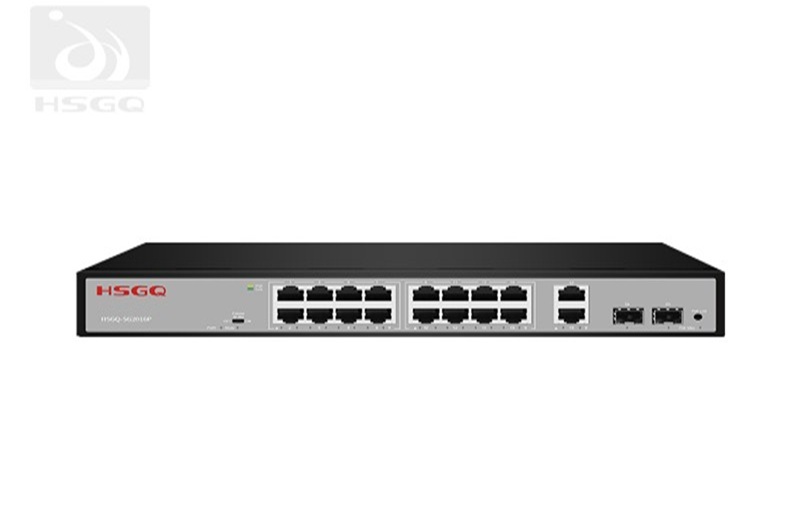
In practical deployment, a PoE switch first identifies whether the connected terminal is PoE-compliant. If the endpoint matches the standard, the switch supplies power while forwarding data traffic; if it is a non-PoE device, the port passes data only. This approach simplifies installation, shortens project time, and keeps cable routing cleaner across surveillance, office, and mixed-access environments. PoE commonly runs over Cat5e or better cabling and helps reduce separate wiring requirements.
Function | What the switch does | Deployment value |
Device detection | Recognizes PoE-compliant terminals automatically | Reduces manual configuration |
Power delivery | Sends DC power over Ethernet to supported devices | Eliminates separate power adapters |
Data switching | Forwards network traffic at the same time | Keeps access devices online through one cable |
Selective behavior | Sends no power to non-PoE devices | Improves compatibility in mixed networks |
This design is especially valuable for IP cameras, wireless APs, VoIP phones, and access control terminals because these devices are often installed on ceilings, corridors, gates, or walls where power outlets are inconvenient. For surveillance builds, a 10/100/1000m poe switch for ip camera is particularly useful because it combines Gigabit bandwidth, automatic PoE supply, and simpler cabling in one access-layer device. HSGQ states that its switch supports 10/100/1000M adaptive Ethernet, automatic power supply for IEEE 802.3af/at devices, up to 30W per port, and uplink plus SFP connectivity for flexible networking, which makes it suitable for HD PoE cameras and AP deployments.
Port count is one of the first indicators of how flexible a PoE deployment can be. A smaller switch may be enough for a compact retail counter or a basic camera cluster, while larger environments need more access ports, better uplink capacity, and room for future devices. HSGQ’s PoE switch range reflects this scaling logic, with product listings that include 8-port, 16-port, 24-port, and 48-port options for surveillance and network access projects. A poe switch 16 port is especially practical for medium-sized deployments because it balances port density, installation simplicity, and expansion headroom for office floors, branch sites, hotel corridors, and typical CCTV zones. HSGQ’s 16-port model is positioned precisely in that range, offering 16 Gigabit PoE ports for networks of different sizes and targeting user access and convergence scenarios such as SMEs, schools, hotels, and industrial parks.
Reliable PoE performance depends on more than having powered ports. The switch also needs recognized IEEE standards, stable per-port output, and a total power budget that matches the actual device mix. Standards-based PoE matters for compatibility, and power planning becomes more important as the number of connected terminals increases. HSGQ states that its 16-port PoE switch supports IEEE 802.3af/at, automatically detects compliant powered devices, and can provide up to 30W on a single port, which is suitable for common IP cameras, access points, and similar terminals. Stable and standards-compliant power delivery is essential in multi-device deployments because one overloaded or mismatched switch can affect camera uptime, wireless coverage, and endpoint reliability across the whole access layer.
Feature area | HSGQ product direction | Why it matters in deployment |
Port scale | 8-port to 48-port portfolio | Fits small, medium, and larger projects more precisely |
PoE standard | IEEE 802.3af/at support | Improves compatibility with mainstream powered devices |
Per-port output | Up to 30W on the 16-port model | Supports many IP cameras, APs, and access terminals |
Uplink design | Electrical and optical uplink options | Helps connect access switches to aggregation or backbone layers |
In professional projects, access ports alone are not enough. Uplink design determines how efficiently traffic can move from edge devices into the broader network. A 16-port PoE switch with both electrical uplink ports and SFP slots can support more flexible network structures across different deployment environments. This matters because Gigabit switching and flexible uplinks are directly tied to video transmission quality, backbone connectivity, and long-term network stability. When surveillance traffic, wireless access, and office data share the same infrastructure, uplink bottlenecks can become just as problematic as insufficient PoE power.
As projects grow, power delivery alone is no longer enough. A cctv managed poe switch adds operational visibility and stronger network control for installers who need VLANs, traffic segmentation, remote supervision, and easier troubleshooting. Managed PoE switching is better suited to more complex networks because it offers more information about device status and power behavior. HSGQ’s current portfolio also shows managed CCTV-oriented PoE products, including 24-port managed models for IP camera deployments, while the 16-port product page mentions PoE QoS priority and configurable operating modes for different networking needs. Those capabilities are particularly valuable in larger security networks, where administrators need to prioritize critical camera traffic, isolate faults faster, and keep the access layer more predictable under real operating pressure.
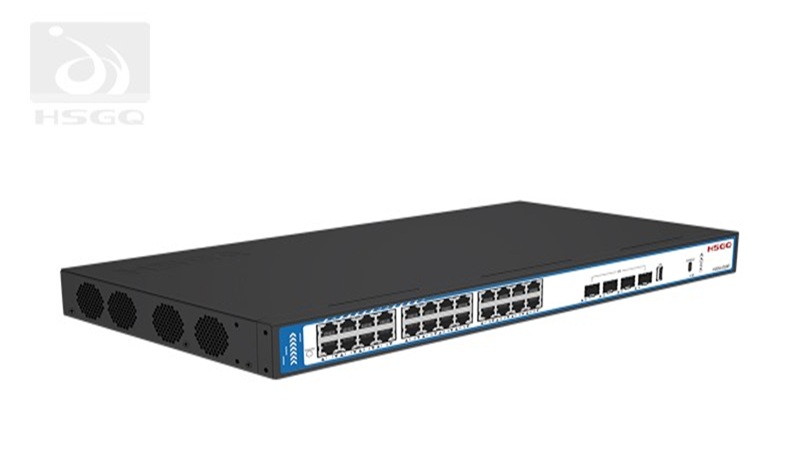
In real surveillance builds, a PoE Switch is usually deployed at the access layer to connect and power IP cameras from a single switching point. This is especially practical in offices, commercial buildings, campuses, retail stores, and perimeter monitoring projects, where cameras are often mounted on ceilings, corridors, entrances, parking zones, or outer walls rather than near power outlets. Instead of running one cable for data and another for electricity, installers can terminate a single Ethernet link to each camera, which makes the topology easier to plan and much faster to implement.
HSGQ positions its PoE switch line clearly around this type of deployment. Its PoE switch category includes CCTV-oriented models such as 8-port, 24-port managed, and 48-port switches for monitor and IP camera projects, while the 16-port model is described for user-network core or convergence use and for Ethernet access scenarios including SMEs, internet cafes, hotels, and schools. The same product page also highlights support for HD PoE cameras, uplink flexibility, and extend-mode remote networking, which fits the real needs of surveillance layouts where camera locations are distributed and traffic must be brought back reliably to the main network.
Deployment type | Typical connected terminals | Main deployment logic |
CCTV in offices and stores | IP cameras, NVR-side uplinks | Centralize camera access and simplify cable routing |
Building and campus monitoring | Corridor, gate, and perimeter cameras | Use one switch to organize multiple camera runs by zone |
Commercial access networks | APs, VoIP phones, access terminals | Combine power and connectivity at the edge |
Hotels, schools, and communities | Room-area APs, cameras, service terminals | Expand coverage without adding separate local power points |
Warehouses and industrial sites | Cameras, wireless nodes, control endpoints | Keep distributed endpoints easier to power and manage |
PoE switching is just as useful in office and commercial networks as it is in surveillance. Wireless access points are frequently ceiling-mounted for better signal coverage, VoIP phones are placed across desks and service counters, and access control devices are installed near doors or gates. In each of these cases, PoE helps avoid scattered power adapters and makes structured cabling more consistent from one floor or branch site to another.
In practice, this creates a more scalable infrastructure. A switch can be placed in a rack or wall-mounted cabinet, with endpoint devices fed through standardized cable runs rather than individually powered at every location. A 16-port PoE switch is often well suited to user access and convergence needs in buildings, offices, and small to medium-sized commercial environments. Electrical uplink ports and SFP uplink options are also useful when traffic from APs, phones, and access devices must be handed off cleanly to the aggregation network.
In hotels, schools, apartment communities, warehouses, and industrial sites, the main challenge is not just powering a single device but coordinating many terminals across a wider physical footprint. A practical PoE deployment usually starts by grouping endpoints by floor, corridor, building wing, or functional area, then assigning them to a nearby switch so cabling stays manageable and future maintenance remains straightforward. This logic is more efficient than treating every camera, AP, or terminal as an isolated installation task.
PoE switches are well suited to multi-scenario deployments across industrial parks, commercial buildings, factories, mines, government facilities, and residential broadband environments. They are also widely used in Ethernet access scenarios such as SMEs, internet cafes, hotels, and schools, where multiple terminals must be connected efficiently. Features such as simple installation, flexible uplink options, and multiple mounting methods including rack, wall, and desktop installation make them practical for environments that range from hospitality corridors to warehouse cabinets.For these environments, the deployment priority is usually clear:
● keep terminal connections centralized by area rather than scattered individually
● reduce local power dependency in places where outlets are inconvenient
● leave room for additional terminals as coverage expands
● maintain a cleaner access layer that is easier to troubleshoot and scale
The first step in selecting a PoE Switch is to count not only the devices you need today, but also the terminals you are likely to add during the next phase of deployment. In surveillance projects, that usually means calculating the number of IP cameras by area, then reserving spare ports for expansion, uplinks, or later additions such as access points and door terminals. Once the number of powered devices increases beyond just one or two endpoints, a PoE switch becomes the more practical choice than separate injectors. For medium-scale deployments, a poe switch 16 port is often the most balanced option because it gives enough access capacity for a typical floor, corridor group, branch office, or camera zone without moving too quickly into oversized hardware. HSGQ’s SG2016P is built around that positioning, with 16 Gigabit PoE ports and application scenarios that include SMEs, hotels, schools, buildings, and industrial sites.
The next question is whether the project needs simple plug-and-play access or deeper network control. An unmanaged PoE switch is usually sufficient when the installation is straightforward and the priority is fast deployment with minimal setup. A managed model becomes more valuable when the network includes multiple camera groups, mixed traffic types, or a need for visibility and fault isolation. A cctv managed poe switch is therefore the better fit when you need VLAN-based traffic separation, better remote monitoring, or easier troubleshooting across larger security systems. HSGQ’s category page includes managed CCTV-oriented models such as a 24-port 2.5G managed switch and a 24-port managed PoE switch for IP camera use, showing that its lineup is designed to scale from simpler installs to more advanced surveillance networks.
Selection factor | Why it matters | HSGQ-related reference point |
Port count | Determines how many endpoints can be connected now and later | 16-port, 24-port, and 48-port PoE options are listed in the PoE category |
Management level | Affects visibility, segmentation, and troubleshooting | Managed CCTV/IP camera models are part of the product range |
Uplink and backbone design | Supports traffic handoff to the wider network | SG2016P provides 2 Gigabit uplinks and 2 Gigabit SFP ports |
Buyers should also evaluate whether the switch can handle actual traffic load, uplink demand, cable layout, and future growth. A 10/100/1000m poe switch for ip camera is especially important in HD surveillance because higher-resolution video streams place more pressure on edge switching and uplink capacity. HSGQ’s SG2016P supports 10/100/1000M self-adaptive Ethernet, includes 2 Gigabit uplink ports plus 2 Gigabit SFP ports, and lists 40Gbps switching bandwidth, which makes it more suitable for sustained video and access traffic than a lower-speed alternative. Distance planning matters too: HSGQ’s product page notes Default and Extend modes, with ports 9–16 forcing 10M in Extend mode to support lower-cost remote networking in longer-reach scenarios.
A PoE Switch delivers power and data through one cable, making deployment simpler and more efficient. It adds clear value in CCTV, IP camera, office, and wireless networks. Buyers should consider port count, power budget, management, bandwidth, and future growth. Shenzhen HS Fiber Communication Equipment CO., LTD. offers reliable PoE solutions with flexible features and practical support for different project needs.
A: A PoE Switch sends data and power over one Ethernet cable to compatible devices.
A: A poe switch 16 port fits medium deployments with multiple cameras, APs, or office endpoints.
A: A 10/100/1000m poe switch for ip camera supports stable bandwidth for HD video and power delivery.
A: A cctv managed poe switch is useful when VLANs, monitoring, and fault isolation are required.