In fiber optic access network deployments, the selection of appropriate terminal equipment directly impacts network costs, deployment efficiency, and equipment integration.
Revolutionizing FTTx Deployment: How HSGQ Power over Fiber (PoF) ONUs Solve the Last Mile Power Problem. Learn how the HSGQ-F100P and HSGQ-F400P PoF ONUs transmit optical data and DC power up to 300 meters via hybrid optical cables, and feature 30W PoE output and cloud management capabilities.
An OLT, or Optical Line Terminal, is the central-side device in a passive optical network (PON). It connects the upstream aggregation or core network with the optical distribution network and manages data transmission to multiple ONU and ONT terminals.
HSGQ provides compact and scalable OLT solutions for GPON, EPON, XGS-PON, FTTH, FTTB, and other fiber access applications. The product range includes Mini OLT, EPON OLT, GPON OLT, GPON Stick OLT, and XGS-PON OLT options for ISPs, telecom operators, enterprise networks, hotels, campuses, and broadband projects.
An optical line terminal is normally installed in a central office, data center, equipment room, or network cabinet. It receives electrical data from the upstream network, converts it into optical signals, and transmits the signals through the optical distribution network to ONUs or ONTs at the user side.
The OLT also receives upstream optical data from connected terminals and converts it back into electrical data for the aggregation network. Through this two-way communication process, one OLT can serve multiple subscribers or remote network endpoints through a PON architecture.
A typical OLT network includes:
The OLT installed at the central office or network room
Optical distribution fiber and passive splitters
ONUs or ONTs installed at homes, offices, buildings, or remote locations
Ethernet, Wi-Fi, voice, video, or other service terminals connected to the ONU or ONT
The optical splitter is a passive component that divides one optical line into multiple downstream branches. The OLT manages the PON ports and communicates with the connected terminals according to the selected access standard and network configuration.
The OLT converts electrical signals from the aggregation network into optical signals for transmission through the fiber access network. It also converts upstream optical signals from ONUs and ONTs back into electrical data.
This optical-electrical conversion allows service providers to extend high-speed access over long fiber links while reducing the need for active equipment between the central office and the user side.
An OLT manages the available bandwidth on each PON port and coordinates communication between multiple connected terminals. Depending on the platform, it may support dynamic bandwidth allocation, upstream and downstream traffic control, port-based rate limiting, traffic shaping, and service priority management.
These functions allow network operators to assign bandwidth according to subscriber requirements, service plans, and network conditions.
The OLT is responsible for discovering, registering, configuring, and monitoring connected ONU and ONT devices. Depending on the model and management system, supported functions may include:
ONU automatic discovery and registration
Remote configuration
ONU status monitoring
Optical link diagnosis
Fault detection
Performance monitoring
Firmware management
VLAN configuration
IGMP snooping and multicast control
Remote maintenance through OMCI or other management interfaces
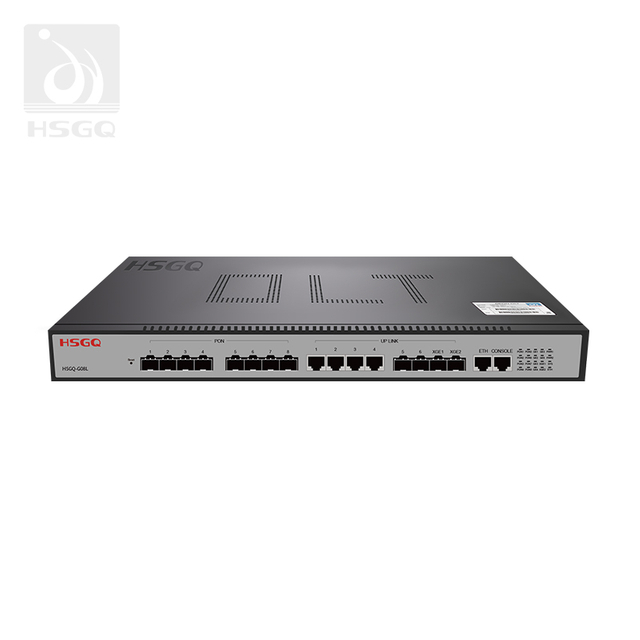
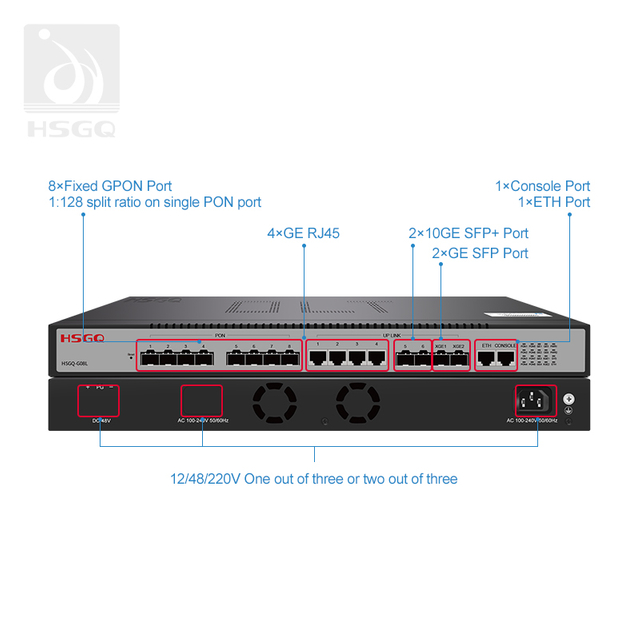
Different OLT models may provide Ethernet uplinks, SFP or SFP+ interfaces, PON ports, console interfaces, and management ports. Depending on the network design, the OLT can support broadband access, enterprise data services, video transmission, voice services, and other IP-based applications.
The exact service interfaces and uplink configuration vary by model, so the required port type, uplink bandwidth, and management method should be confirmed before selection.
HSGQ offers several OLT configurations for different network sizes, PON standards, deployment environments, and upgrade requirements.
A Mini OLT is designed for projects that require a compact form factor, lower equipment density, or flexible installation. It can be suitable for small ISPs, rural broadband projects, hotels, residential buildings, small campuses, and enterprise access networks.
Compared with a high-density chassis OLT, a Mini OLT generally occupies less space and can simplify installation in smaller equipment rooms or network cabinets. It should be selected according to the required PON port count, ONU capacity, uplink interface, management functions, and future expansion plan.
Explore the Mini OLT category for compact GPON and other small-scale fiber access solutions.
EPON OLTs use Ethernet Passive Optical Network technology to deliver fiber-based broadband access. They can be used in FTTH, FTTB, campus, hotel, surveillance, and small-business network projects where EPON compatibility is required.
When choosing an EPON OLT, network operators should check the number of PON ports, supported ONU quantity, uplink bandwidth, VLAN functions, multicast management, and compatibility with the intended EPON terminals.
The EPON OLT category provides access equipment designed for EPON-based fiber networks.
GPON OLTs are widely used in residential broadband, apartment buildings, hotels, office buildings, and other FTTx deployments. A GPON OLT can connect multiple ONUs through passive optical splitters and provide centralized subscriber management from the network side.
GPON OLT selection should consider:
Number of PON ports
Supported ONU capacity
Optical transmission budget
Uplink interface and bandwidth
VLAN and QoS functions
OMCI and remote management support
Power supply and redundancy options
Compatibility with the selected GPON ONU or ONT
HSGQ provides GPON OLT options for different FTTH, FTTB, and fiber access requirements.
A GPON Stick OLT uses a compact SFP-style form factor and can be integrated into a compatible network switch, router, or host device. This design can be useful when the project requires a small footprint, simplified equipment deployment, or a lower-cost GPON access solution.
GPON Stick products should be evaluated according to host-device compatibility, SFP interface requirements, supported management method, optical specifications, GPON profile, and ONU interoperability.
The GPON Stick category is intended for compact GPON access and space-constrained network applications.
XGS-PON OLTs are designed for higher-bandwidth access networks that require faster upstream and downstream transmission. They can support next-generation FTTH, enterprise access, cloud services, high-density video, campus networks, and other applications with growing bandwidth requirements.
XGS-PON is suitable for projects that need greater capacity and a longer upgrade path. However, the complete network must be planned as a system, including the OLT, optical distribution network, splitters, ONUs or ONTs, optical budget, uplink capacity, and subscriber equipment.
Review the XGS-PON OLT category for high-bandwidth fiber access solutions.
The PON standard determines how the OLT communicates with the connected ONU or ONT terminals. GPON, EPON, and XGS-PON are not automatically interchangeable, so the OLT and endpoint equipment must be selected as a compatible system.
Before deployment, confirm the following:
PON protocol and operating mode
Optical wavelength
Transmit and receive optical power
Split ratio
Maximum optical loss
Connector type
ONU or ONT authentication method
OMCI or other management compatibility
VLAN and service profile requirements
Uplink interface and total bandwidth
A dual-mode or multi-mode device may provide greater deployment flexibility, but it should still be tested with the intended ONU, ONT, OLT management platform, and optical distribution network.
In Fiber to the Home deployments, the OLT is installed at the central office or ISP equipment room. It connects to passive splitters and serves ONUs or ONTs installed in individual homes or apartments.
The OLT manages subscriber access, bandwidth allocation, VLAN services, and remote terminal maintenance.
In Fiber to the Building applications, the OLT provides fiber connectivity to a building or property and distributes network access to multiple rooms, offices, or tenants.
GPON, EPON, or XGS-PON OLTs can be selected according to the required bandwidth, subscriber density, building size, and existing optical infrastructure.
Internet service providers can use OLTs to manage multiple subscribers from a centralized location. The correct port density and uplink configuration help operators scale the network as more users or service areas are added.
OLT-based fiber access networks can provide centralized management for guest rooms, apartments, offices, and shared facilities. Operators can use VLANs, bandwidth control, and remote maintenance to separate users and simplify daily administration.
Schools, office parks, medical facilities, and industrial sites may use OLTs to connect buildings or remote network zones through fiber. XGS-PON can be considered when the network requires higher capacity for cloud applications, video services, wireless access, or large numbers of connected users.
Start by confirming whether the network requires GPON, EPON, XGS-PON, or another PON standard. The selected OLT must match the ONU or ONT equipment and the service requirements of the project.
The required number of PON ports depends on the number of connected users, the planned split ratio, the coverage area, and the expected network growth. A higher port count may be more suitable for large projects, while a Mini OLT may be sufficient for smaller deployments.
The uplink interface connects the OLT to the aggregation or core network. Check whether the project requires Gigabit Ethernet, 10G SFP+, combo uplinks, or other interfaces.
The uplink should have sufficient capacity for the total traffic generated by all active PON ports and connected subscribers.
The OLT must work with the selected ONU or ONT devices in terms of PON mode, optical budget, authentication, management protocol, VLAN configuration, and service profile.
For managed network projects, check whether the OLT supports OMCI, web management, CLI, local console access, cloud management, VLAN, QoS, IGMP snooping, multicast control, and optical diagnostics.
For smaller network rooms, a compact OLT can reduce space requirements. For larger or more critical deployments, the project may require redundant power, higher port density, stronger thermal management, and additional uplink flexibility.
The OLT and ONU or ONT work together but perform different functions.
The OLT is installed on the central network side. It manages PON ports, communicates with multiple terminals, allocates bandwidth, and connects the access network to the upstream aggregation network.
The ONU or ONT is installed on the user side. It receives the optical signal from the OLT and converts it into Ethernet, Wi-Fi, voice, video, or other local network services.
A complete PON deployment therefore requires compatibility between the OLT, optical distribution network, splitter, fiber cable, and ONU or ONT terminals.
OLT stands for Optical Line Terminal. It is the central-side device used to connect an upstream network with a passive optical access network.
An OLT is normally installed at the central office or network room and manages multiple optical terminals. An ONU or ONT is installed at the user side and converts the optical signal into Ethernet, Wi-Fi, voice, video, or other local services.
Neither standard is universally better. GPON and EPON use different technical standards and may be preferred according to the existing network, ONU compatibility, bandwidth requirements, service model, and management platform.
An XGS-PON OLT is suitable when the network requires higher capacity, greater upstream bandwidth, or a longer-term upgrade path. It may be considered for high-density FTTH, enterprise networks, campuses, cloud applications, and bandwidth-intensive services.
A GPON Stick OLT is used when a compact SFP-style access solution is preferred. It can be suitable for space-limited installations and network designs that use a compatible switch, router, or host device.
The number of supported ONUs depends on the OLT model, PON port count, optical split ratio, management capacity, service profile, and optical budget. The maximum theoretical capacity should not be treated as the recommended deployment capacity without considering bandwidth and maintenance requirements.
Before purchasing, confirm the PON standard, PON port count, uplink interface, ONU compatibility, optical budget, split ratio, management functions, VLAN and QoS requirements, power design, installation environment, and future expansion needs.