Views: 0 Author: Site Editor Publish Time: 2026-04-03 Origin: Site
Many fiber projects need fast deployment, but not a large OLT from day one. That is why mini GPON is gaining attention. In this article, you will learn how a mini GPON OLT fits real FTTH builds, when it works better than larger options, and what to know about black GPON fiber and mini GPON OLT files download.
Mini GPON OLT is best suited to projects that need dependable fiber access but do not justify a full-size, high-port-density platform. In practical terms, that usually means installations where the network must be stable, easy to deploy, and cost-conscious from the start. Instead of investing in oversized equipment with unused capacity, operators can use a compact OLT to deliver broadband, voice, or video services in a more targeted way. This is especially relevant in FTTH builds where subscriber numbers are still limited, in SOHO environments where space is tight, and in small enterprise sites that need business-grade access without a complex rack setup. The appeal is straightforward: fast rollout, reduced hardware footprint, and a lower entry barrier for fiber deployment. These priorities align with the needs of small-scale access scenarios.
The strongest use cases for mini GPON OLT are those where one compact node can serve a defined group of users efficiently, without the waste associated with larger OLT systems.
Deployment scenario | Why mini GPON OLT is a strong fit |
Small apartment buildings and rental housing | Supports shared fiber access in buildings with limited telecom space and modest subscriber counts |
Villas and community FTTH | Works well for low-density residential clusters that need stable broadband without centralized large-scale equipment |
Small enterprise offices | Delivers fiber access for office connectivity, IP phones, and internal business applications in a compact form |
IoT and video surveillance networks | Handles converged data transport where reliability matters more than very high user density |
Beyond these settings, mini GPON OLT is also practical in edge cabinets, remote broadband extension points, and localized service expansion projects. In these environments, the real advantage is not simply that the device is smaller, but that it allows fiber deployment to match actual demand rather than theoretical maximum scale.
For many buyers, the first question is not “How many ports can I buy?” but “How quickly and efficiently can I launch service?” Early-stage projects often face uncertain subscriber growth, limited installation space, and strict budget control. In that context, compact deployment matters more than chasing raw port density.
Key buying priorities often include:
● faster installation in cabinets, corridors, or utility rooms
● lower upfront investment while demand is still forming
● simpler power and maintenance requirements
● easier expansion from pilot stage to broader rollout
This is why mini GPON OLT often makes better operational sense in the beginning. It lets service providers, property managers, and integrators start with a right-sized fiber access platform, validate demand, and scale later only when user growth truly requires higher-port GPON equipment.
For smaller fiber projects, the most important question is rarely maximum capacity. It is whether the deployment can be launched quickly, economically, and without creating unnecessary operational overhead. That is where mini GPON OLT has a clear advantage. A single-port or low-port compact unit is often a better fit when subscriber numbers are still limited, when the site has very little rack or cabinet space, or when the project is being rolled out in stages. Instead of paying for multiple ports that may sit idle for months, operators can match equipment size to actual demand and keep early capital spending under control. This makes mini GPON OLT especially attractive for pilot FTTH projects, small residential clusters, boutique commercial sites, and edge access nodes.
Another reason mini GPON OLT works well in smaller builds is installation simplicity. Compact models usually require less power, less cooling, and less structured space planning than larger fixed-port systems. In practice, that means they can be deployed in telecom cabinets, utility rooms, or wall-mounted boxes where a higher-port chassis would be impractical. Maintenance is also easier at this scale because the number of active subscribers, fiber links, and service profiles is still manageable. For distributed projects, this can matter more than raw port count, since the goal is often to activate service with minimal complexity rather than build for peak scale on day one.
As deployment scale increases, the advantages of larger GPON OLTs become more apparent. Once subscriber growth is predictable, the trade-off changes from “avoid overbuilding” to “improve density and operational efficiency.” At that stage, higher-port devices are often the smarter choice.
OLT type | Best-fit deployment stage | Main operational advantage |
Mini GPON OLT | Pilot, localized, or low-density projects | Lowest entry cost and easiest deployment |
4-port GPON OLT | Growing but still controlled FTTH rollout | Better balance between expansion room and manageable cost |
8-port GPON OLT | Regional or medium-density access | Higher subscriber density with stronger long-term ROI |
16-port GPON OLT | Centralized, high-density aggregation | Best for large user concentration and efficient centralized management |
A 4-port GPON OLT becomes suitable when a project has clearly moved beyond trial deployment but still does not require large-scale aggregation. It offers expansion headroom without immediately pushing the operator into a higher-capacity platform. An 8-port GPON OLT is better aligned with regional access builds or medium-density residential coverage, where the operator wants stronger port efficiency and cleaner long-term scaling. A 16-port GPON OLT makes sense when subscriber concentration is high enough that centralized management, uplink aggregation, and rack efficiency start to outweigh the flexibility of smaller devices.
A practical way to choose is to start from deployment structure instead of hardware ambition. Stay with mini GPON OLT when the build is localized, phased, or constrained by space. This is common in one-building FTTH, small office access, remote extension points, and projects where demand still needs to be validated. Move to a larger OLT when three pressures begin to appear together: subscriber growth becomes steady, centralized management starts reducing operational effort, and aggregated bandwidth demands make higher port density more efficient. At that point, scaling up is not just about adding more ports. It is about improving cost per subscriber, simplifying network operations, and aligning the access layer with a more mature service footprint.
A mini GPON OLT should be judged by how well it supports the network you actually plan to build, not by product size alone. The first checkpoint is the balance between PON port count, uplink design, and ONU capacity. A compact unit may be ideal for a micro FTTH project, but it still needs enough uplink headroom and subscriber capacity to avoid becoming a bottleneck too early. Beyond port planning, buyers should also look at management capability. Remote access, cloud-based operation, and automatic ONU handling reduce the burden on field teams and make small deployments easier to scale.
Reliability is another practical filter. In small projects, equipment is often installed in tight cabinets, shared telecom rooms, or edge locations where on-site support is limited. That makes stable operation, long-distance fiber access, and deployment flexibility more important than feature overload. A mini GPON OLT that supports strong monitoring and predictable performance is usually more valuable than a larger unit with more ports but unnecessary complexity.
Buying checkpoint | Why it matters in practice |
PON ports and ONU capacity | Determines whether the device matches current demand without forcing early replacement |
Uplink design | Affects backhaul efficiency and future traffic growth |
Cloud and remote management | Reduces maintenance effort across distributed sites |
Automatic ONU handling | Speeds provisioning and lowers configuration workload |
Reliability and access distance | Helps ensure stable service in remote or space-constrained deployments |
Installation flexibility | Makes compact deployments easier in cabinets, wall boxes, or small offices |
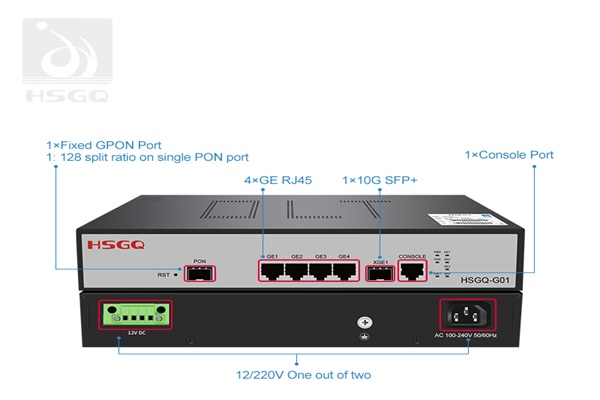
The HSGQ 1-port and 2-port models reflect two common buying priorities in small fiber deployments: starting with the right capacity and keeping room for practical expansion. The HSGQ-G01 is designed for FTTH, home office use, and small business environments where space is limited and deployment needs to stay simple. With 1 fixed GPON port, 4 GE RJ45 ports, 1×10G SFP+, and 1 console port, it offers a compact setup that is easier to install and manage in low-density projects. Features such as cloud management and support for up to 128 GPON users also make it a sensible option for operators that want a lightweight access platform without unnecessary hardware overhead.
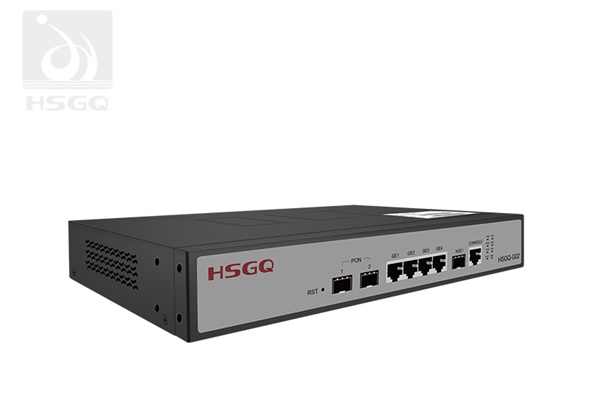
The HSGQ-G02 is better suited to projects that need more subscriber capacity but still want to keep deployment compact and cost-aware. It is positioned for home broadband access, small enterprise broadband access, and security monitoring, using 2 fixed GPON ports, 4 GE RJ45 ports, 1×10G SFP+, and 1 console port. With support for up to 256 ONUs, it gives buyers a practical step up from a single-port model while avoiding the jump to a larger fixed-port OLT too early. This makes it a better fit for projects that are already growing, but are not yet ready for 4-port or higher-density platforms.
When evaluating a mini GPON OLT, buyers should look beyond hardware wyaspecifications and consider the quality of its long-term support resources. In real deployments, the device is only one part of the investment. Firmware packages, user manuals, configuration files, upgrade tools, and maintenance documents all affect how easily the OLT can be installed, managed, and restored after faults. This is why searches related to mini GPON OLT files download are often highly practical rather than informational. In many cases, users are not just comparing products. They are checking whether the platform can be maintained efficiently over time.
Download support matters before purchase because it reveals how workable the product will be in day-to-day operations. A platform with limited firmware access or unclear documentation can increase downtime, delay troubleshooting, and make future changes harder to manage. For small FTTH or edge-access projects, this is especially important because technical teams are often lean and on-site visits can be costly. In that context, update resources are not secondary extras. They are part of the product’s operational value.
Support resource | Why it matters |
Firmware packages | Improve stability, patch software issues, and support feature updates |
Manuals and operation guides | Reduce setup mistakes and shorten maintenance time |
Configuration files or templates | Simplify deployment consistency and system recovery |
Upgrade instructions | Lower the risk of failed updates and service interruption |
Maintenance records and compatibility notes | Help with ONU management and future planning |
A safe update process starts with validation, not installation. Operators should first confirm the exact model and hardware version, then verify that the selected firmware package matches that device revision. Before any upgrade begins, the current configuration should be backed up so the system can be restored if needed. Only after that should the firmware file be uploaded through the supported management method, followed by reboot and service verification.
A practical workflow usually includes:
● identifying the device model and hardware revision
● saving the current running configuration
● checking firmware compatibility before upload
● confirming successful file transfer before reboot
● verifying service status, ONU registration, and key functions after restart
● recording the new software version for future maintenance
Upgrade planning should distinguish between three separate actions. Firmware updates keep the OLT stable, secure, and functionally current. ONU batch upgrades improve subscriber-side management without replacing the central platform. Hardware scaling happens when the project moves from a 1-port mini GPON OLT to a 2-port or larger OLT because user count and traffic demand have grown.
This makes a mini GPON OLT more than a short-term access device. It can serve as the first stage of a broader network plan, allowing operators to start with compact deployment, maintain service through controlled updates, and expand only when growth justifies a larger platform.
A mini GPON OLT is often the most efficient starting point for compact FTTH and edge-access projects because it combines deployment flexibility, lower initial cost, and easier scaling. As subscriber density grows, 4-port, 8-port, or 16-port GPON OLTs become the better choice for higher-capacity and more centralized networks. Shenzhen HS Fiber Communication Equipment CO., LTD. supports this type of growth with compact GPON solutions that help operators build practical networks today while keeping room for future expansion.
A: A mini GPON OLT is used for small FTTH, small office, and edge-access deployments where space, power, and cost are limited.
A: Mini GPON is better when subscriber counts are low, rollout is phased, and avoiding unused port capacity matters.
A: Before mini GPON OLT files download, confirm model, hardware version, firmware compatibility, and backup status.